Belarus Country Passport
Belarus beyond Lukashenka: political power, repression, a history shaped by more than Russia, and a society whose stories deserve to be heard.
Albert Stulens - Facts checked 22 October 2026
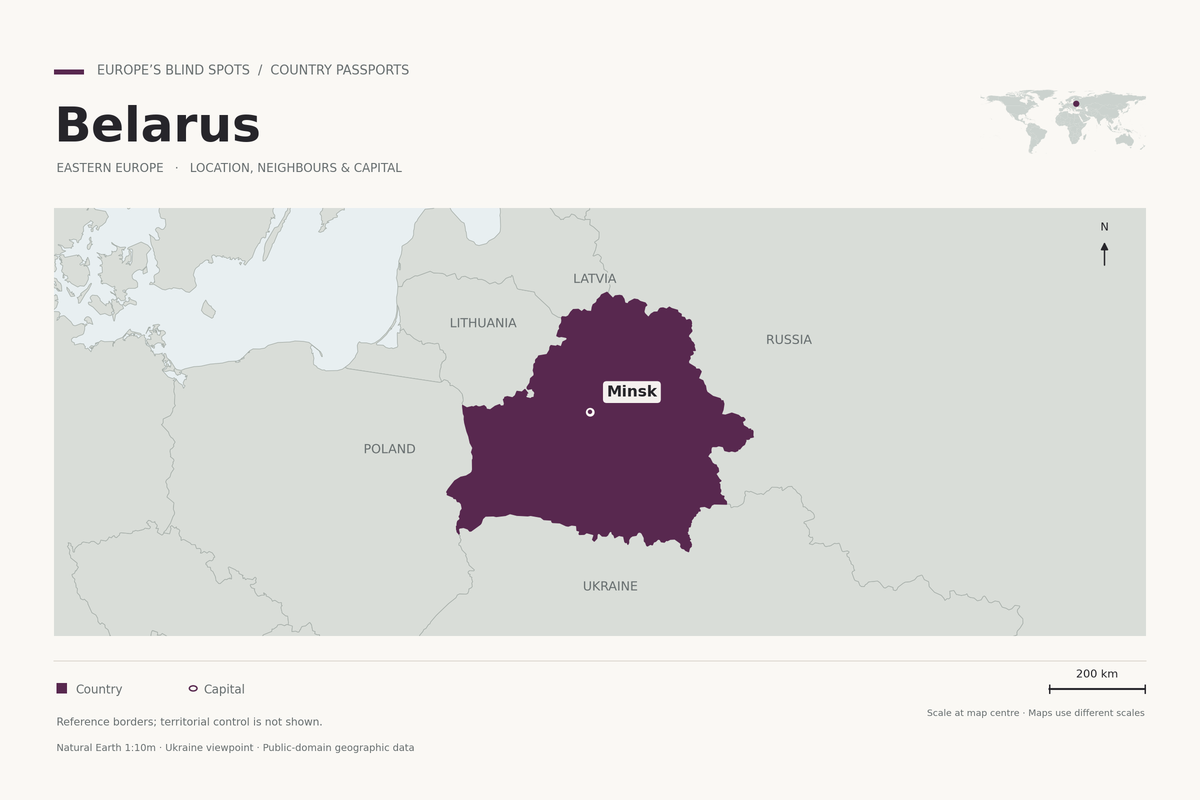
Belarus (BY) lies between the European Union, Russia and Ukraine. Alyaksandr Lukashenka has led the country since 1994, but its society and history extend far beyond the regime and its ties to Moscow. This passport connects political institutions with the past and with stories that repression and geopolitics can obscure.
Essential facts
|
Capital |
Minsk |
|
Population |
Approximately 8.94 million. UN projection for 1 July 2026, medium
variant of World Population Prospects 2024; not a current population count.
[1] |
|
Languages |
Belarusian and Russian are both state languages. Russian dominates
everyday use. Minority languages include Polish and Ukrainian. [2] |
|
Currency |
Belarusian rouble (BYN). |
|
International ties |
United Nations; Commonwealth of Independent States; Organization for
Security and Co-operation in Europe; Collective Security Treaty Organization;
Eurasian Economic Union; Shanghai Cooperation Organisation, since 2024.
Belarus is not a member of the Council of Europe. [3, 4] |
|
Neighbours |
Russia, Ukraine, Poland, Lithuania and Latvia. |
Political system and power
Political institutions. Belarus is formally a presidential republic. Alyaksandr Lukashenka is its first and, so far, only president since the office was introduced in 1994. Parliament consists of the Council of the Republic, with 64 regular seats, and the House of Representatives, with 110 seats. The 2022 constitutional changes also gave the All-Belarusian People’s Assembly constitutional status; Lukashenka chairs this body too. These institutions provide no independent check on his power. [2, 5]
Power in practice. Lukashenka and his security apparatus, including the KGB, control the state. Following the election of 26 January 2025, he was declared the winner for a seventh term, officially receiving 86.82 per cent of the vote. The election was neither free nor fair; the other candidates posed no real challenge to his power. [6, 7]
Electoral conditions. Universal suffrage exists on paper, but registration requirements, party bans and repression prevent free political competition. The Organization for Security and Co-operation in Europe could not observe the 2025 election: an invitation arrived only ten days before polling, too late to assess the process properly. [7]
Opposition. Open, independent political organisation is virtually impossible within Belarus. Many opposition figures, activists and journalists have been imprisoned or have fled abroad. At the end of September 2026, Viasna counted 876 recognised political prisoners. This is a documented count at a specific date; political repression reaches further. Sviatlana Tsikhanouskaya is one of the leading representatives of the democratic movement in exile. [8, 9]
Democracy and the rule of law
Belarus is among Europe’s least free countries. The judiciary provides no independent check on power, torture and ill-treatment in detention are documented, and the death penalty remains in place. Independent media and civil society organisations have been banned or dissolved on a large scale; others work underground or from exile. [9, 10]
|
Indicator |
Result |
Edition and
reference year |
|
Freedom House [5] |
Not Free |
2026 |
|
V-Dem [11] |
Liberal Democracy Index |
2026 report |
|
Press freedom [12] |
27.72 out of 100 |
2026 index |
|
Corruption perceptions [13] |
31 out of 100 |
CPI 2025 |
Higher scores indicate more favourable outcomes in these indices. They measure different things. The corruption index measures perceived public-sector corruption, rather than the number of corruption cases.
Historical turning points
Fourteenth to eighteenth centuries. Much of present-day Belarus belongs to the Grand Duchy of Lithuania, which forms part of the Polish-Lithuanian Commonwealth from 1569. The Ruthenian chancery language, also called Old Belarusian, serves administration and the courts. Orthodox, Catholic, Jewish and later Eastern Catholic communities shape the cultural landscape. This history extends well beyond Moscow. [14, 15]
1654–1667. War between the Polish-Lithuanian Commonwealth and Russia turns Belarus into a battlefield. Violence, famine, epidemics and forced displacement cause severe depopulation. Estimates of a population decline of around half are not an established death toll. The ‘Deluge’ chiefly refers to the Swedish invasion of 1655-1660, within this wider period of warfare. [14, 26]
1772–1795. The partitions of the Polish-Lithuanian Commonwealth bring the Belarusian territories under the Russian Empire. Particularly in the nineteenth century, language policy, education and religious measures intensify Russification. In 1839, much of the Eastern Catholic Church in the Russian Empire is absorbed into the Orthodox Church. [14]
1918–1921. On 25 March 1918, the Belarusian Democratic Republic declares independence under German occupation. It acquires little effective state authority. After further wars, the Treaty of Riga in 1921 divides the territories between Poland and Soviet Belarus. The white-red-white flag remains a symbol of self-determination. [14, 16]
1941–1944. German occupation brings mass murder and devastation. The Nazis and their collaborators murder hundreds of thousands of Jews on Belarusian territory, including people deported from elsewhere. Other civilians, prisoners of war and partisans are also killed on a massive scale; villages are destroyed with their inhabitants. Estimates of total population losses vary with boundaries and methods of counting. The regime later uses war memory to reinforce its claims to stability and legitimacy. [16, 17]
1986. The Chernobyl nuclear disaster contaminates large areas of Belarus with radioactive material. Evacuation, health concerns, loss of homes and long-term economic consequences make the disaster a turning point whose effects extend far beyond Ukraine. [18]
1991. Belarus becomes independent as the Soviet Union dissolves. Many Soviet institutions and administrative elites remain in place. The later dictatorship is nevertheless not an inevitable consequence of independence. [14]
1994. Lukashenka wins the first, competitive presidential election. The populist anti-corruption campaigner subsequently builds an authoritarian system. Some Soviet symbols return, many enterprises remain in state hands, and closer relations with Russia culminate in the Union State Treaty of 1999. [14, 19]
1996-2004. The constitutional crisis and referendum of 1996 weaken parliament and strengthen the presidency. Presidential term limits are removed in 2004. The 2022 referendum restores a limit, but excludes previous terms from the count, offering no immediate prospect of a transfer of power. [2, 19]
2020. The falsified presidential election triggers an unprecedented wave of protests. Peaceful demonstrators, women, workers, local networks and digital initiatives reveal a broad social movement. Extreme violence, mass arrests and exile follow. The movement extends beyond the urban technology elite. [9, 19]
2022-2023. Belarus makes its territory available for Russia’s invasion of Ukraine. In 2023, Russia and Belarus conclude an agreement on Russian tactical nuclear weapons; both governments subsequently state that weapons have been transferred. Precise numbers and operational readiness cannot be fully verified independently. Dependence on Moscow deepens. [20, 21]
Blind spots
A society and history of its own
Belarus is not a ‘little Russia’. Its ties with Russia are extensive, but its own language, its past within the Grand Duchy of Lithuania and the Polish-Lithuanian Commonwealth, and its varied religious traditions give it a distinct history. Russification has placed that diversity under pressure. Speaking Russian should not automatically be read as political support for Moscow. [14, 15]
An economy beyond state enterprises
The economy has never been exclusively state-run. Before 2020, an internationally connected information technology sector grew alongside the dominant state enterprises. Repression and emigration have since shifted substantial expertise and many businesses to countries including Poland and Lithuania. This does not mean that the sector has disappeared inside Belarus. The diaspora maintains economic and social connections with the European Union. [22]
An opposition broader than its leaders
The democratic movement encompasses more than Tsikhanouskaya and other familiar faces. Human rights defenders, independent media, trade unionists and local networks also sustain it. Focusing only on visible organisations underestimates both the significance of 2020 and the risks under which independent citizens now live. [9, 19]
Sovereignty under pressure
Russia’s military presence and economic integration restrict Belarus’s room for independent action. Yet formal annexation is not a foregone conclusion, and integration proceeds at different speeds. A dependent neighbour already gives Moscow considerable influence without full incorporation. ‘Creeping annexation’ describes the risk of increasingly hollowed-out sovereignty. This process takes place amid harsh domestic repression. [21, 23]
Exile as a political reality
Working abroad, Tsikhanouskaya’s Office, the United Transitional Cabinet and the Coordination Council develop political representation and prepare for a possible democratic transition. The Coordination Council held online elections in 2024, but is not a conventionally elected national parliament. Nor does the ‘New Belarus Passport’ project provide a generally recognised replacement travel document. The movement also advocates practical solutions for people with expired Belarusian passports. [24]
Relations with the European Union
Relations with the regime have been substantially downgraded since the electoral fraud and repression of 2020. The EU imposes sanctions while supporting independent media, civil society organisations and democratic forces. The forced landing of a passenger aircraft in 2021, the border crisis fomented by the regime and support for Russia’s war have further damaged relations. Connections with Belarusian society have nevertheless endured. [20]
Belarus supports Russia’s war politically, logistically and militarily; there is no broadly confirmed deployment of regular Belarusian combat units in Ukraine. Relations with Poland, Lithuania, Latvia and Ukraine are severely strained. Lukashenka periodically seeks openings with Western governments, including through prisoner releases, while repression continues. [8, 9, 20, 27]
Sources and methodology
Facts checked on 22 October 2026. Publication years and reference years are distinguished where necessary. Official election results describe what the authorities report; they do not establish that an election was free or fair. The number of political prisoners is a dated count of recognised cases. State sources are used with a distinction between formal rules, government statements and the actual exercise of power.
1. UN population projection - World Population Prospects 2024, medium variant for 1 July 2026, displayed through PopulationPyramid.net. Belstat’s national population figure uses a different basis and reference date.
2. Constitution of Belarus - Official text and explanation of the amendments of 1996, 2004 and 2022; languages, parliament, presidency and People’s Assembly.
3. International organisations - Official Belarusian report to the UN, including full membership of the Shanghai Cooperation Organisation from 4 July 2024.
4. Council of Europe - Parliament’s special guest status was suspended on 13 January 1997; relations with the authorities were suspended in March 2022.
5. Freedom House - Freedom in the World 2026, Belarus; score of 7 out of 100, assessing 2025.
6. Viasna and the Belarusian Helsinki Committee - Elections 2025, final analytical report; official result of 86.82 per cent and assessment of the electoral process.
7. International election observation - Joint statement by the EU, United Kingdom, Canada, Australia and New Zealand, 27 January 2025; late invitation to the OSCE.
8. Viasna - Human rights situation in Belarus, September 2026, published on 6 October; 876 political prisoners at the end of the month.
9. Human Rights Watch - World Report 2026, Belarus; repression, detention, exile and the death penalty.
10. UN human rights investigation - Findings on unlawful detention, persecution and torture, discussed in the EU statement to the Human Rights Council on 19 March 2025.
11. V-Dem Institute - Democracy Report 2026, p. 48; scores for 2025, rounded to two decimal places.
12. Reporters Without Borders - World Press Freedom Index 2026; Belarus, score of 27.72 and rank 165 of 180.
13. Transparency International - Corruption Perceptions Index 2025, published in 2026; score of 31 and rank 124 of 182.
14. Universal Lithuanian Encyclopaedia - Baltarusijos istorija; historical development, the war of 1654–1667, the partitions and Russification.
15. Ruthenian chancery language - Slavų kanceliarinė kalba, Universal Lithuanian Encyclopaedia; terminology and functions in the Grand Duchy.
16. YIVO Encyclopedia - Belarus; Jewish history, the interwar period and territorial division under the Treaty of Riga.
17. The Holocaust and war - US Department of State, JUST Act Report, Belarus; also the US Holocaust Memorial Museum’s account of Minsk. USHMM
18. United Nations - Background to International Chernobyl Disaster Remembrance Day; consequences for Belarus.
19. Historical and political background - Freedom in the World 2025, Belarus; more extensive background than the abridged 2026 edition.
20. European External Action Service - The European Union and Belarus; relations with the regime and support for society. The political prisoner count follows source 8, rather than the older figure on this overview page.
21. Congressional Research Service - Belarus, edition of 28 January 2026; military cooperation, the Union State and government statements on nuclear weapons.
22. OSW Centre for Eastern Studies - A depopulating country, 17 October 2023; demographics, emigration and the departure of skilled workers.
23. OSW Centre for Eastern Studies - No breakthrough as planned, 27 February 2026; slow implementation of economic integration with Russia.
24. Democratic movement in exile - The movement’s own explanation of its institutions and passport issues, alongside reporting on the passport project’s limited recognition. Passport issues, August 2026; Belsat, February 2026
25. Natural Earth - Admin 0 Countries, 1:10 million scale, Ukraine point of view. Geographical data are in the public domain; map design by Europe’s Blind Spots.
26. Seventeenth-century demography - Jerzy Morzy’s study of the demographic crisis in Belarus and Lithuania, also documenting displacement and deportation.
27. Ukraine and Belarus - Ukraine’s Ministry of Foreign Affairs on bilateral relations; the Canadian Institute of Ukrainian Studies on the continuation of diplomatic relations; AP on the border situation, July 2026. CIUS, July 2026; AP, July 2026