Moldova Country Passport
Discover Moldova through its politics, history and European aspirations, with a closer look at migration, Gagauzia, Transnistria and the Dniester.
Albert Stulens - Facts checked 24 October 2026
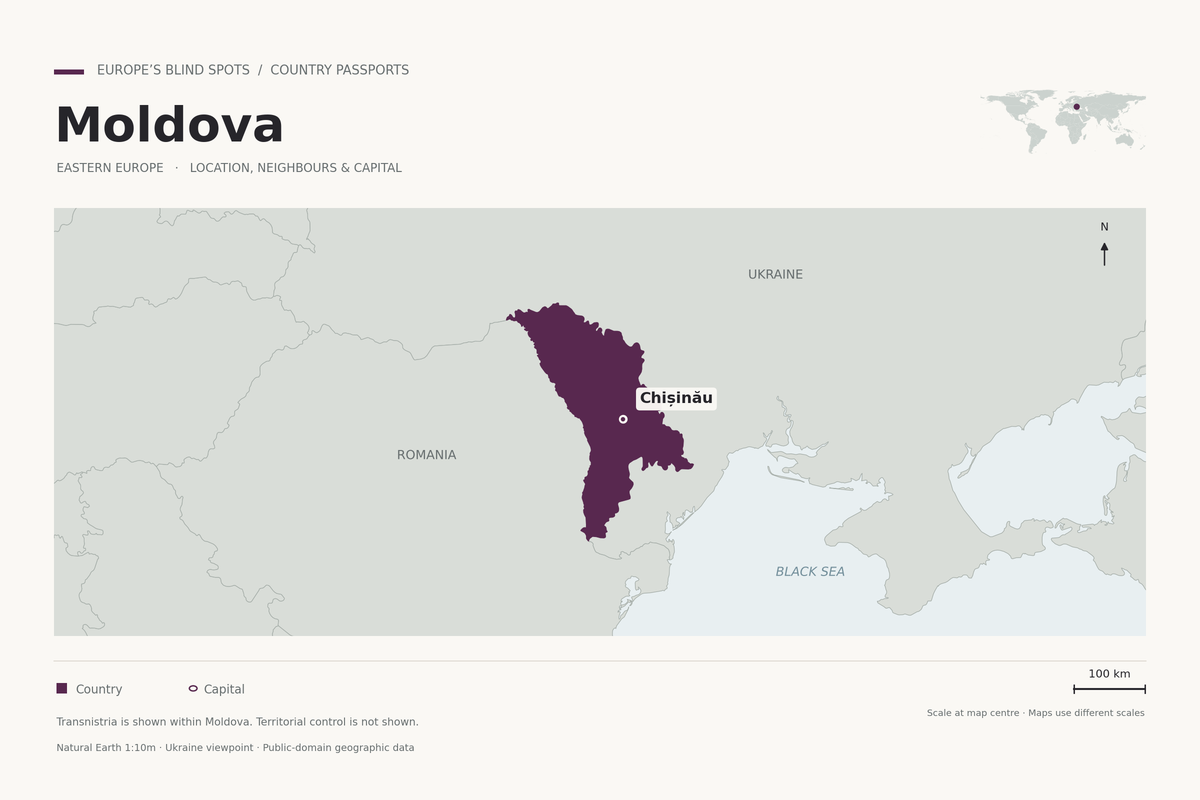
Moldova (MD) lies between Romania and Ukraine. Its path towards the European Union attracts considerable attention, but behind elections and Russian pressure are also stories of language and identity, migration and regional diversity. This passport connects those stories with the political institutions and history of a country seeking to decide its own future.
Essential facts
|
Official name |
Republic of Moldova. |
|
Capital |
Chișinău. |
|
Population |
Approximately 2.37 million usual residents on 1 January 2026, a
provisional national estimate. Areas outside Chișinău’s de facto control are
excluded. [1] |
|
Languages |
Romanian is the state language. Other languages spoken include Russian,
Ukrainian, Gagauz, Bulgarian and Romani. Language use and national identity
do not automatically coincide. [2, 3] |
|
Currency |
Moldovan leu (MDL). |
|
International ties |
United Nations; Council of Europe; Organization for Security and
Co-operation in Europe; World Trade Organization. EU candidate since June
2022. Constitutionally neutral; not a NATO member. [2, 16] |
|
Neighbours |
Romania and Ukraine. Transnistria is internationally recognised as part
of Moldova, rather than a neighbouring country. [10] |
Political system and power
Political institutions. Moldova is a republic with a directly elected president and a government accountable to a unicameral parliament of 101 members. Maia Sandu has been president since December 2020 and was re-elected in November 2024. After consulting the parliamentary groups, the president nominates a prime minister; the government requires parliament’s confidence. Vasile Tofan has been prime minister since 22 July 2026. [2, 4, 28]
Power in practice. President Sandu and the governing Party of Action and Solidarity (PAS) support European integration. In the election of 28 September 2025, PAS won 50.2 per cent of valid votes and 55 seats; the Russia-aligned Patriotic Bloc received 24.2 per cent and 26 seats. The government therefore has a majority, while facing opposition, public criticism and independent scrutiny. [5]
Electoral conditions. Parliament is elected for four years through proportional representation; the president serves a four-year term, with a second round of voting if necessary. Observers from the Organization for Security and Co-operation in Europe (OSCE) assessed the 2025 election as competitive, offering a genuine choice. They identified serious foreign interference, illicit financing, vote-buying and disinformation, as well as shortcomings by the authorities: late legislative changes, doubts about impartial decisions and inadequate remedies following party exclusions. [2, 5]
Opposition and regions. Alongside the Patriotic Bloc, Alternativa, Our Party and Democracy at Home entered parliament in 2025. Gagauzia has legally recognised autonomy within Moldova. Transnistria is governed by a separatist de facto administration supported by Russia, a different administrative and legal situation. [5, 20]
Democracy and the rule of law
Moldova has political competition and largely protected basic freedoms. Judicial and anti-corruption reforms remain necessary. Networks of economic influence, weak institutions and pressure on the media constrain democratic oversight. A European orientation does not in itself establish uninterrupted democratic progress. [6, 8, 9]
|
Indicator |
Result |
Edition and
reference year |
|
Freedom House [6] |
Partly Free |
2026 |
|
V-Dem [7] |
Liberal Democracy Index |
2026 report |
|
Press freedom [8] |
74.77 out of 100 |
2026 index |
|
Corruption perceptions [9] |
42 out of 100 |
CPI 2025 |
Higher scores indicate more favourable outcomes; the indices measure different things. Freedom House assesses Transnistria separately. The corruption index measures perceptions of public-sector corruption, rather than the number of criminal cases.
Historical turning points
1812. The Russian Empire annexes the eastern part of the Principality of Moldavia, between the Prut and Dniester rivers. This territory becomes known as Bessarabia. The division creates a lasting fault line within a largely Romanian-speaking historical region. Today’s state borders do not match those of the former principality. [10]
1918-1949. Bessarabia unites with Romania in 1918. In 1940, the Soviet Union annexes the territory and establishes the Moldavian Soviet Socialist Republic, also incorporating land east of the Dniester. During Romanian and German military operations and occupation from 1941, Jews are persecuted, murdered and deported. Soviet rule returns in 1944. Repression and deportations, including the mass deportation of July 1949, leave deep scars. [10, 11, 12]
1991-1994. Moldova declares independence on 27 August 1991. War with Transnistria’s separatist authorities follows in 1992, with Russian troops playing a decisive role. The de facto separation endures. The 1994 constitution enshrines permanent neutrality; a separate law recognises Gagauzia’s autonomy that year. [2, 10, 20]
2001-2009. Vladimir Voronin serves as president, backed by the Party of Communists. Disputed elections in April 2009 are followed by protests and violence; pro-European coalitions subsequently take power. The popular term ‘Twitter Revolution’ emphasises digital mobilisation and explains only part of this political shift. [13, 15]
2014-2021. Around one billion US dollars disappears from three banks in the run-up to the 2014 crisis. The scandal undermines confidence in the political elite and financial oversight. The political crisis of 2019 breaks oligarch Vladimir Plahotniuc’s dominant position. Sandu wins the presidential election in 2020; PAS secures a parliamentary majority in 2021. [14, 15, 28]
2022-2026. Russia’s full-scale invasion of Ukraine increases security and energy pressures. Moldova becomes an EU candidate in June 2022; accession negotiations open on 25 June 2024. In October 2024, a narrow majority supports a constitutional amendment on EU accession. The loss of Russian gas supplies in January 2025 causes a severe crisis, particularly in Transnistria. Several negotiating clusters with the EU open in 2026. [16, 17, 18]
Blind spots
Romania and overlapping identities
Hundreds of thousands of Moldovan citizens also hold Romanian citizenship, giving them access to live and work in the European Union. Political reunification with Romania is debated, but is not a preference that can be assumed for every citizen. In the census, people use both ‘Moldovan’ and ‘Romanian’ to describe their identity and language. Self-identification, linguistic relationships and the legally designated state language are distinct matters. [3, 10]
Migration and the diaspora
Between the 2014 and 2024 censuses, the usual resident population fell by 13.6 per cent within the territory covered by the census. Emigration, low birth rates and ageing put pressure on families, public services and the labour market. Remittances help households make ends meet, but also create vulnerabilities. The diaspora is also a source of knowledge, connections and political engagement. [1, 19]
Autonomy and language in Gagauzia
Gagauz belongs to the Turkic language family; the Gagauz people are predominantly Orthodox Christians. Gagauzia has had its own regional institutions since the autonomy settlement of 1994. Russian plays a major role in public life, and political preferences aligned with Russia are strongly represented. Yet the population, its language and regional leaders’ interests are not interchangeable. Relations with Chișinău also concern powers, education and economic opportunities. [20, 21, 3]
The Dniester as a lifeline
The Dniester, known in Romanian as the Nistru, supplies drinking water to Chișinău and much of the country. Drought, climate change and river-basin management make water supplies vulnerable. Hydropower plants affect the river’s flow regime and require cross-border agreements. In summer 2026, the OSCE reports exceptionally low inflows. Moldova and Ukraine consult through their joint river commission on water releases and use. [22, 23]
Transnistria between dependence and connection
Transnistria has a Russian military presence and an authoritarian de facto administration, but its society and economy remain connected to Moldova and the EU. Many residents hold Moldovan documents. According to the Moldovan authorities, around 71 per cent of goods exports by businesses in the region went to the EU in 2025. This is a trade figure and does not directly establish political preferences. [24, 29, 30]
Relations with the European Union
Moldova has been an EU candidate since June 2022 and has been negotiating accession since June 2024. The Association Agreement, including the Deep and Comprehensive Free Trade Area, has long provided a basis for closer economic and legal ties. The opening of negotiating clusters in 2026 marks progress, without guaranteeing accession by a predetermined date. [16, 17]
The European Union supports reforms and investment through a Reform and Growth Facility of around €1.9 billion for 2025–2027, largely in loans and conditional on reforms. The civilian EU Partnership Mission in Moldova (EUPM Moldova) advises on crisis management, cybersecurity and foreign information manipulation. Its mandate runs until 31 May 2027. [25, 26]
The war in Ukraine increases the need for energy security and protection against foreign interference. Moldova’s neutrality does not rule out practical cooperation with the EU and other partners. Citizens also judge European integration by what it delivers for incomes, public services, reliable justice and the ability to build a future in their own country. [2, 19, 25]
Sources and methodology
Facts checked on 24 October 2026. Population figures specify their reference date and territorial coverage. Index publication years and reference years are distinguished. Government sources document formal decisions and their own statistics; independent observers assess political practice. The map shows internationally recognised national borders, not territorial control.
1. National Bureau of Statistics - Provisional population estimate for 1 January 2026: 2,365,600; final census figure for 8 April 2024: 2,409,207. The census excludes areas outside the constitutional authorities’ de facto control. Final 2024 census results
2. Constitution of Moldova - Current Romanian-language text; including Articles 11, 13, 60, 63, 78, 80 and 98 on neutrality, language, parliament, the president and government. Judgment of 11 March 2024 on Article 13
3. National Bureau of Statistics - Final ethnocultural results of the 2024 census, published on 20 October 2025; ethnicity and language are self-reported.
4. Government of Moldova - Swearing-in of Prime Minister Vasile Tofan and his cabinet on 22 July 2026.
5. OSCE ODIHR - Final report on the parliamentary election of 28 September 2025, published on 18 February 2026; assessment and results, Annex I. Percentages are calculated from the valid votes listed there.
6. Freedom House - Freedom in the World 2026: Partly Free, 60/100. Transnistria is excluded from this assessment.
7. V-Dem Institute - Democracy Report 2026, Table A2, p. 48; data for 2025: Liberal Democracy Index 0.45 and Electoral Democracy Index 0.55.
8. Reporters Without Borders - World Press Freedom Index 2026: score 74.77 and rank 31 of 180.
9. Transparency International - Corruption Perceptions Index 2025, published in February 2026: 42/100, rank 80 of 182; compared with 43/100 in 2024.
10. Congressional Research Service - Moldova: Background and U.S. Policy, 2025; historical borders, Transnistria and Romanian citizenship. Political developments in this older report have been checked against more recent sources.
11. United States Holocaust Memorial Museum - Deportation of Jews from Balti, Bessarabia; Romanian persecution, murder and deportation of Jews during the Second World War.
12. Estonian Internal Security Service - Annual Review 2023–2024, War Crimes section; archival documents on the Stalinist deportation operation in Moldova in July 1949.
13. Presidency of Moldova - Biography of Vladimir Voronin, president from 4 April 2001 to 11 September 2009.
14. World Bank - Analysis of bank failures and related-party transactions; Moldova’s 2014 case, in which around one billion US dollars disappeared from three banks.
15. Political background - Congressional Research Service on the change of government in 2019; OSCE archive with reports on the elections of 2009 and 2021. OSCE election archive
16. Council of the European Union - First accession conference on 25 June 2024; formal opening of negotiations, following candidate status in June 2022.
17. Council of the European Union - Current country overview; clusters 1 and 6 opened in June and July 2026, and clusters 2 and 3 on 13 October 2026.
18. European Commission - Emergency support for the energy crisis, 27 January 2025; Gazprom had ceased providing the region’s contractually agreed gas supplies on 1 January.
19. World Bank - Moldova country overview; poverty, emigration, ageing, remittances and structural economic constraints. Its income classification is upper-middle-income.
20. OSCE Mission to Moldova- Rule of law; the 1994 autonomy law and the division of powers between Chișinău and Gagauzia.
21. US Helsinki Commission - Report on the 1998 elections; historical background on Gagauz autonomy, the Turkic language and Orthodox tradition. For current language data, see source 3.
22. OSCE - Project on transboundary management of the Dniester; drinking water, agriculture, hydropower and ecosystems.
23. OSCE - Low-water crisis and consultations between Moldova and Ukraine, 28 August 2026; exceptionally low inflows and agreements on water releases.
24. Government of Moldova - Bureau for Reintegration Policies, 14 January 2026; around 71 per cent of goods exports from the Transnistrian region went to the EU in 2025. This is a government statistic.
25. Council of the European Union - Extension of the civilian EU Partnership Mission in Moldova until 31 May 2027, announced on 21 May 2025.
26. European Commission - Reform and Growth Facility for Moldova, providing up to around €1.9 billion for 2025–2027; funding is conditional on reforms.
27. Natural Earth - Admin 0 Countries, 1:10 million scale, Ukraine point of view. Geographical data are in the public domain; map design by Europe’s Blind Spots.
28. Presidency of Moldova - Biography of Maia Sandu; first took office on 24 December 2020 and was re-elected on 3 November 2024.
29. Freedom House - Freedom in the World 2026, Transnistria; separate assessment of dependence on Russia, restricted political competition and repression.
30. Government of Moldova - Bureau for Reintegration Policies, 9 July 2026; Moldovan citizenship and identity documents among registered residents of the Transnistrian region. Registration is not a census of people actually living there.