A Democracy Without a Horizon Becomes a Marketplace of Egos
From Trump’s America to Europe’s technocratic drift, democracy is threatened not only by extremism, but by the slow loss of moral horizon. When politics becomes money, management and spectacle, Europe must rediscover itself as a political union.
I have long had reservations about certain aspects of the United States. Not about America as a country, nor about its citizens, and certainly not about the rich democratic tradition that also belongs to its history. My concern lies elsewhere: in the cultural and political traits that have increasingly come to dominate public life - superficiality, the worship of money, politics as spectacle, and the idea that success is measured almost exclusively in wealth, visibility and power.
The Decadence of Power
Donald Trump did not invent those traits. But he has turned them into a grotesque caricature. He is a kind of inverted King Midas: everything he touches is transformed not into gold, but into spectacle, greed and moral decay. Power, in his hands, is not responsibility. It is scenery. The presidency becomes a brand. Democratic institutions become props. Elections become reality television.
Trump is not merely an accident of the system. He is the emanation of a deeper problem: a political culture in which money and power have replaced truth, history, dignity and public responsibility. He has no real respect for history, for institutions, for truth, or ultimately for democracy itself. Everything is subordinated to personal advantage.
That inevitably leads to immoral politics, both at home and abroad. If politics is reduced to power and money, people too become instruments. Allies become transactions. Citizens become target groups. Vulnerable communities become budgetary burdens. International relations become real estate deals. Democracy is no longer treated as a shared civic project, but as an instrument to be used for as long as it remains useful.
When Money Replaces Morality
The United States will not restore its democracy simply by electing a different president. That may be necessary, but it is not sufficient. The obsession with money has to be removed from the heart of politics. The destructive influence of extreme campaign financing, billionaire networks, lobbying machines and private money in public life must be limited. This problem did not arise from one single law, one president or one court ruling. It is the result of a broader evolution in which democratic politics has become increasingly dependent on wealth. A democracy in which political power appears to be for sale will sooner or later lose the trust of its citizens. And without trust, democracy is reduced to procedure.
The European Echo
But it would be far too easy to pretend that this is only an American problem. The real question is not why Trump became possible in the United States. The real question is why the logic that made him possible is gaining ground elsewhere too.
In Europe, and certainly in Belgium, parts of politics are also participating in a form of decadence. Not always in the same vulgar or theatrical way, but often with the same underlying emptiness: image over substance, power over responsibility, money over dignity, numbers over people. Above all, there is a growing inability to speak about society as a moral project.
The same temptation is visible in Belgian politics. Bart De Wever’s political language often revolves around budgetary discipline, efficiency, productivity and the question of who or what is still “useful.” Of course budgets matter. Of course governments must deal seriously with public finances. But a country is not an accounting file, and a society is not an Excel sheet.
When the search for cheap energy tempts politicians to reopen relations with Vladimir Putin, politics risks losing its moral hierarchy. Energy prices cannot be separated from war, freedom, human rights and European security. The same is true when budgetary discipline becomes the overriding political virtue: even waiting lists for people with disabilities risk being discussed primarily as a fiscal problem rather than as a question of dignity and rights. Public finances cannot be separated from the dignity of those who depend on public care.
The politics of Georges-Louis Bouchez reflects a related danger in a different register: politics as permanent positioning, personal power and the near-moralisation of economic growth. GDP becomes more than an indicator; it becomes almost a measure of human worth. Those who contribute to growth count. Those who need protection, support or time are too easily treated as obstacles.
But that is not liberalism in the richer sense of the word. Genuine liberalism is not only about markets and competition. It is also about freedom, the rule of law, pluralism, responsibility and human dignity. Once that ideological foundation disappears, all that remains is a cynical power game. And once the ground of conviction has disappeared, the road is open for opportunists: politicians who do not act from belief, but from calculation; people who turn with the wind as long as it pushes them forward.
Nor is this temptation limited to the right. Across the political spectrum, parties increasingly trade worldview for marketing, ideology for packaging, and society for strategy. That is the deeper problem: politics becomes performance and management, while the moral question - what kind of society do we want to be? - disappears.
The Technocratic Temptation
This is where the deeper danger lies. Politics is increasingly becoming technocracy. It is about processes, budgets, tables, procedures, efficiency and management. It is less and less about values, ideology, direction and destiny. As if politics were merely a management problem. As if governing only meant keeping the machine running. As if the question “What works?” were more important than the question “What is just?”
Hannah Arendt warned against this danger. For Arendt, politics was not merely administration or production. Politics was action among people, in freedom and plurality. It was the space in which citizens speak, judge, disagree, choose and begin again. When politics is reduced to management, that public space disappears. Society is then administered as a process, not carried as a community.
There is an authoritarian temptation hidden in that reduction. Not always loudly. Not always brutally. Not always in uniform. Sometimes authoritarianism comes in the language of efficiency. In the language of “there is no alternative.” In the language of budgetary necessity, discipline and numbers. Once politics is no longer about choices, but about alleged inevitabilities, the democratic core begins to disappear. Dissent becomes an obstacle. Values become sentimental. Vulnerable people become “costs.” Morality becomes inefficient.
That is why the debate about ideology remains so important. One may criticise Guy Verhofstadt for many things, but he was right on one essential point: politics without ideology becomes empty. Not because we need to return to old party reflexes, closed pillars or rigid doctrines, but because democracy needs direction. A society needs ideas about freedom, equality, justice, solidarity, power and responsibility.

Politics Needs a Horizon
Great democratic politics has always needed such a horizon. Abraham Lincoln spoke at Gettysburg of a “new birth of freedom.” Franklin D. Roosevelt framed the struggle against fascism through the Four Freedoms. Ronald Reagan spoke of a “shining city upon a hill”, a vision of America as a moral promise, however much one may disagree with his policies. Willy Brandt dared to say “Mehr Demokratie wagen” - dare more democracy - not less democracy, but more; not less citizenship, but more; not less public participation, but more public responsibility. Václav Havel reminded Europe that politics without truth ultimately becomes nothing but power.
Europe itself was born from such a horizon. Robert Schuman and Jean Monnet did not turn coal and steel into a technocratic project. They turned them into a peace promise. Altiero Spinelli did not see European federalism as an institutional hobby, but as an answer to nationalist self-destruction. Jacques Delors understood that Europe cannot live on market and currency alone. Europe needs a soul, a story, a moral core.
What these examples have in common is that they did not reduce politics to management. They spoke of destiny. Of freedom, dignity, peace, democracy and truth. That is precisely what is too often missing today. We have budgets, tables and campaign strategies, but too little horizon. We speak of growth, but not of civilisation. Of efficiency, but not of justice. Of power, but not of responsibility.
A country needs a budget. But a country also needs a horizon.
Without a horizon, politics becomes a struggle between accountants, marketers and power brokers. The public space becomes poorer. The central question is no longer: “What kind of society do we want to be?” but only: “Who wins today?” or “What does it yield?”
That is the real decadence. Not wealth in itself. Not growth in itself. Not power in itself. But the loss of any higher purpose. The moment when public responsibility is replaced by personal ambition. The moment when ideology disappears and only image remains. The moment when politics is no longer a moral project, but a career path.
Trump is the most grotesque symbol of that development. But he is not the exception that should reassure us. He is the warning we must take seriously.
Europe as a Political Union
This is especially true for Europe. As long as the European Union is experienced mainly as a market, a currency, a regulatory framework or a budgetary mechanism, it will remain vulnerable. Not because those things are unimportant, but because they are insufficient. No democracy lives by procedures alone. No political community can survive on directives, tables and compromise texts.
Europe must therefore dare to become more clearly what it already partly is: a political union. Not only an internal market, but a community of fate and values. Not only a negotiation machine between member states, but a democratic project with its own voice, its own direction and its own responsibility towards citizens.
That means, among other things, a real common foreign policy. Not twenty-seven hesitant statements, but a European voice that makes clear where we stand: towards Russia, towards China, towards the United States, towards authoritarian regimes, towards war, colonial aggression and digital dependency. If Europe wants to be taken seriously geopolitically, it must first take itself seriously.
A Union That Tells Its Own Story
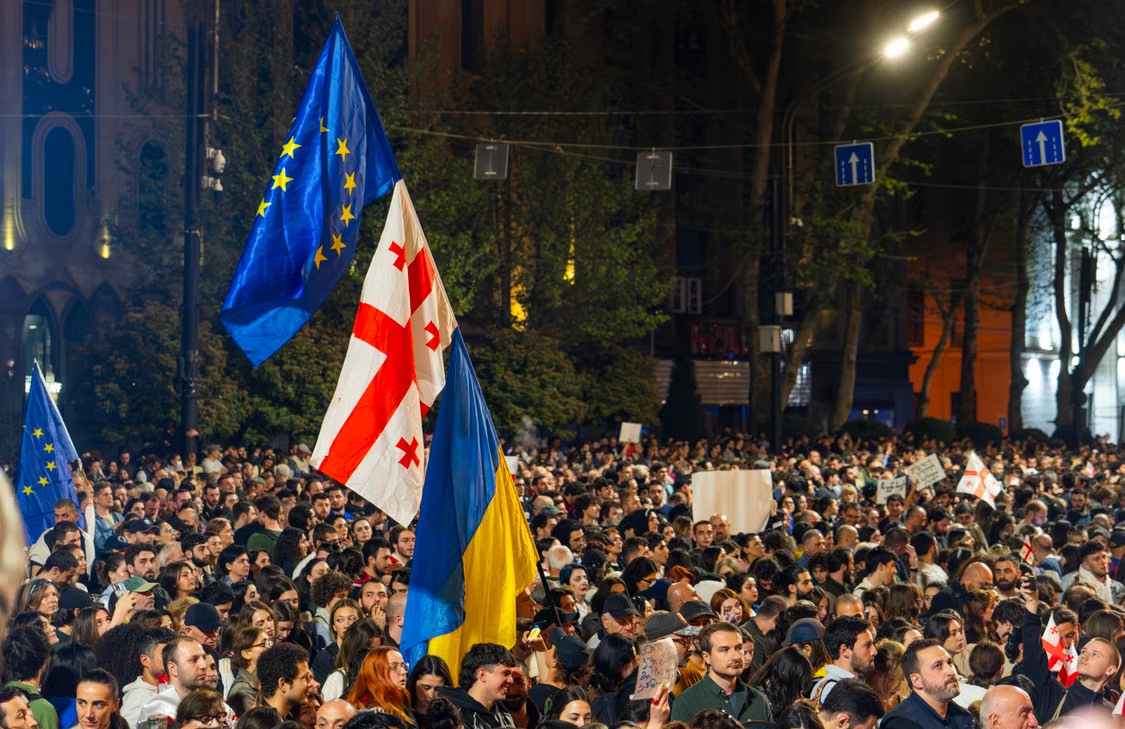
But this also requires something else: European communication channels of its own. Not propaganda, not self-glorification from Brussels, but democratic public service. Europe must dare to speak directly to citizens. About Ukraine. About digital autonomy. About energy. About defence. About the rule of law. About disinformation. About climate. About why certain choices are made, what is at stake, and which values stand behind them.
Today, we leave that story far too often to national governments, party-political framing or hostile information networks. As a result, Europe becomes visible in many member states only when a scapegoat is needed. National politicians claim successes as their own, while difficult compromises are blamed on “Brussels.” No mature political union can function in this way.
Europe needs representatives who communicate actively, visibly and on a broad scale with citizens. Not only in parliamentary committees or press conferences after summits, but in schools, media, civic forums, universities, local communities and digital platforms. A European democracy must also build a European public sphere. Without a public sphere, there is no shared responsibility. Without shared responsibility, there is no democratic Europe.
That is why every member state should have a full minister for Europe. Not as a ceremonial figure, not as a junior appendix to foreign affairs, but as a central political actor in government. Someone responsible for the national translation of European decisions. Someone who explains why Europe matters. Someone who forms the bridge between European decision-making and national democracy.
Such a minister would not merely prepare European summits, but also answer to parliament, publicly defend European choices, inform citizens and connect national debates to European reality. Europe must no longer be something that happens “above” citizens. It must become something that lives among them.
For Ukraine, this would mean that European governments do not only announce military or financial support, but constantly explain why that support concerns our own freedom and security. Not in technocratic language, but in political language: Ukraine is not only defending territory. It is defending the principle that borders cannot be changed by force, and that peoples have the right to decide their own future.
For digital autonomy, it means that citizens understand why dependence on a handful of American or Chinese technology companies is not a technical detail, but a democratic question. Whoever controls our data, our infrastructure and our information flows has power over our societies. Digital autonomy is therefore not merely a technical file. It is a form of democratic self-protection.
That is the great task: to make Europe visible again as a moral and political project. Not only as a market organising efficiency, but as a community protecting freedom. Not only as a regulator, but as the bearer of a civilisational idea. Not only as a machine, but as a promise.
If Europe fails to take that step, it will remain trapped in the same technocratic thinking that is hollowing out national politics. Europe too will then become a process without a story, a structure without a soul, a compromise without a horizon. A Union that makes laws but tells no story will eventually leave its citizens to nationalists, cynics and foreign propagandists.
But if Europe dares to speak as a political union, it can once again do what Schuman, Monnet, Spinelli and Delors understood: use technique in the service of a higher moral purpose. The internal market, the euro, defence cooperation, digital autonomy, climate policy and foreign policy would no longer be separate dossiers. They would become parts of one story: that Europeans can protect their freedom, dignity and democracy only when they organise them together.
The Spirit of Democracy
A society that only asks what something yields will eventually forget what holds it together.
And a democracy without a moral horizon sooner or later becomes a marketplace of egos. In such a marketplace, victory does not go to the person who is most right, but to the one who shouts the loudest, pushes the hardest and is least hindered by scruples.
That is why we need politics with substance, character and direction. Not less vision, but more. Not less ideology, but better ideology. Not more empty slogans about responsibility, but a serious conversation about what responsibility means: towards one another, towards the weakest, towards democracy itself.
Democracy rarely dies in one blow. More often, it first becomes thinner. More superficial. More cynical. Harder. Emptier. Until one day the institutions are still standing, but the spirit has disappeared.