The Day Politics Took Sides
Left and right began as seats in a revolutionary assembly. They still shape politics, but today's decisive divide increasingly runs between pluralist democracy and concentrated power, and nowhere is that choice clearer than in Ukraine.
Why left and right still matter and why they no longer explain enough
Before Left and Right
Long before left and right became political concepts, both directions already carried symbolic meaning. In the Bible, the right hand signifies power, protection and blessing. At the Last Judgement in the Gospel of Matthew, the righteous stand on the right and the condemned on the left. Everyday language preserved that distinction. The English word right and the German Recht also refer to what is correct or just. The French gauche acquired an additional sense of awkwardness, while the Italian sinistra is related to the Latin sinister, which could also mean threatening or unfavourable.
This older symbolism did not give rise to the modern political distinction. It does help explain why the words expressed more than positions in a chamber from the beginning. The right sounded familiar, lawful and honourable. The left more readily acquired associations with deviation and resistance. In 1789, politics gave these old words a new meaning.
A Chamber Finds a Political Language
The importance of 1789 can scarcely be overstated. The Bastille was stormed on 14 July. Between 4 and 11 August, the National Constituent Assembly adopted the August Decrees, dismantling the privileges of the nobility and clergy and much of the feudal order. The Declaration of the Rights of Man and of the Citizen followed on 26 August. These events did not end the ancien régime in a single stroke, but they made clear that its foundations were no longer untouchable.
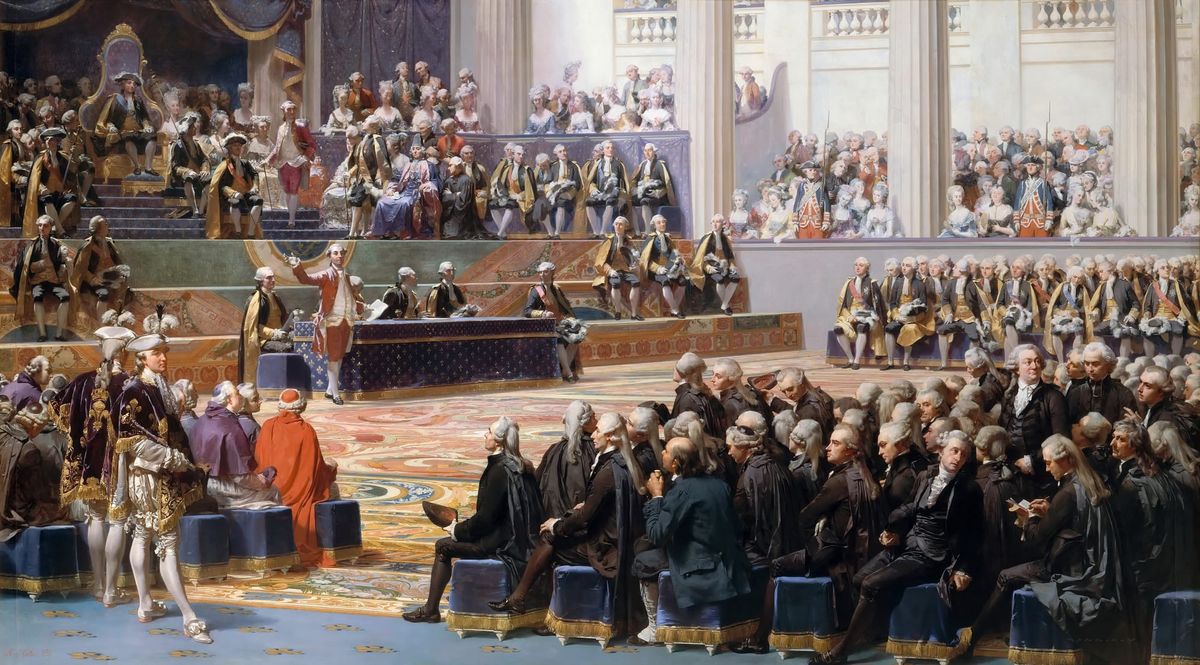
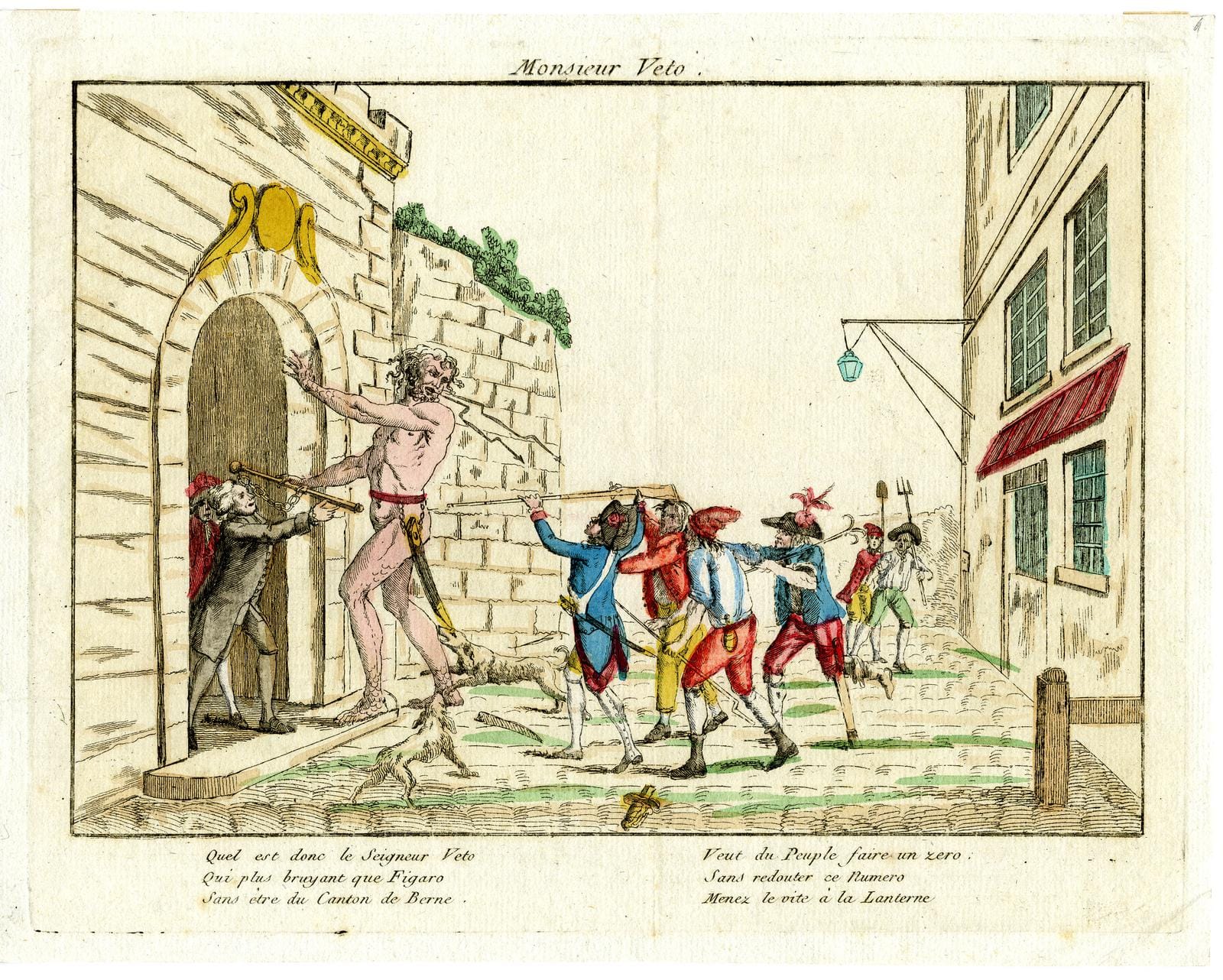
On 11 September, that rupture acquired a political floor plan. The deputies debated Louis XVI's right of veto. The central question was how much power the king should retain in the new constitutional order. Supporters of a strong or absolute royal veto gathered to the president's right. Opponents, who would permit at most a temporary suspensive veto, sat on the left. The spatial division had already become visible during the debates in late August. The vote of 11 September is regarded as its conventional birthday because it made the opposition unmistakable.
The result was clear. According to the parliamentary record, 673 deputies voted against an absolute veto and 325 in favour; eleven votes were lost or invalid. The king eventually received a suspensive veto. He could delay legislation, but not block it permanently.
It would be too simple to divide the chamber into monarchists and democrats. Several opponents of an absolute veto wanted to retain the monarchy. Among its supporters was Jean-Joseph Mounier, a reformer who defended a constitutional monarchy and a bicameral system modelled on Britain's. Emmanuel-Joseph Sieyès and Maximilien de Robespierre opposed a royal veto that could obstruct the representation of the nation. Mirabeau also favoured a constitutional monarchy, but assigned an important role to the executive. The positions did not line up neatly along the boundary between old and new.
That is precisely what makes the moment significant. The terms were not designed by a philosopher or enshrined in a constitution. They emerged almost accidentally from a concrete conflict over power. Who was entitled to block the decisions of the representatives? How far did the king's power extend? Where did sovereignty reside? From that point onwards, a seat in the chamber could signify a political worldview.
From Estates to Citizens
At the beginning of 1789, French society was still formally divided into three estates. The First Estate consisted of the clergy and the Second of the nobility. The Third Estate included everyone who did not legally belong to the first two. This was the overwhelming majority of the population: members of the middle classes, craftspeople, workers and peasants. Their deputies, however, were not a cross-section of that population. They were men and generally belonged to the educated, property-owning bourgeoisie. The Parisian crowd was not in the chamber.
Even so, the representatives of the Third Estate made a revolutionary claim. They declared that they represented not only their own estate, but the nation. Political legitimacy could no longer derive exclusively from birth, ecclesiastical rank or royal authority. Article 3 of the Declaration of the Rights of Man and of the Citizen established the principle that the source of all sovereignty resides essentially in the nation.
The events of August and September must therefore be distinguished. The August Decrees dismantled the legal privileges of the ancien régime. The declaration of 26 August formulated liberty and equality as universal rights. The veto vote of 11 September revealed how the new political order was becoming divided within itself. Together, these moments marked a transition from representation based on hereditary status to a politics that invoked citizens and the nation.
That transition did not yet produce a full democracy. Suffrage remained restricted, women were excluded and slavery continued in the French colonies. The Revolution proclaimed universal principles that it applied only partially. Its later strength lay precisely in that tension. Those who remained outside the new order could invoke its own language of liberty and equality.
The Long Century of Emancipation
During the nineteenth and twentieth centuries, the left increasingly came to signify a challenge to inherited hierarchy. The right more often stood for continuity, property, religion, authority and nation. The distinction remained recognisable, but neither camp stayed the same. The liberal movement fought absolutism and the privileges of the estates. Socialists and social democrats organised workers and linked political rights to social protection. Women's movements challenged a conception of citizenship that proclaimed liberty while excluding half the population. Civil-rights movements and the emancipation of LGBTQ+ people subsequently broadened the question of who was recognised as an equal citizen.
The French Revolution itself also revealed the distance between principle and reality. Women played a decisive part in events, including the March on Versailles, but received no political equality. The National Convention abolished slavery in 1794; Napoleon restored it in 1802. France did not abolish it definitively until 1848. The Revolution opened new possibilities even as it excluded people. It combined fundamental rights with violence, popular sovereignty with the Terror.
History cannot therefore be reduced to a pure struggle between an emancipatory left and a reactionary right. Movements of the left could combine emancipation with authoritarian rule. Parties of the right, in turn, learned to live with constitutions, universal suffrage and the welfare state. Christian democracy later emerged from Catholic social thought, workers' organisations and the acceptance of mass democracy. It made social protection, human dignity and European cooperation parts of a political tradition that cannot simply be described as an attempt to restore the ancien régime.
The clubs and factions of the Revolution were not modern political parties either. The Girondins were not early liberals in the present sense, and the Jacobins were not precursors of social democracy. The Revolution did, however, set themes in motion that liberals, socialists, conservatives and Christian democrats later adopted and changed. A place in the chamber became a historical axis along which successive movements for emancipation tried to arrange their opponents and allies.
The Victory That Emptied the Future
Two centuries after the French Revolution, another upheaval seemed to confirm the direction of history. The fall of the Berlin Wall in 1989 and the collapse of the Soviet Union in 1991 brought the Cold War to an end. Communism lost its credibility as a universal alternative to liberal democracy and the market economy.
Francis Fukuyama gave that confidence a famous formulation. His essay The End of History? appeared in 1989; the book The End of History and the Last Man followed in 1992. He did not claim that wars or political conflicts would cease. His argument was that liberal democracy no longer faced a convincing universal ideological rival. The great question about the endpoint of political development seemed to have been answered.
In the same period, part of European social democracy moved towards the centre. In Beyond Left and Right, published in 1994, Anthony Giddens examined how progressive politics should adapt to globalisation, individualisation and the weakening of old class ties. Tony Blair spoke of New Labour, Gerhard Schröder of Die Neue Mitte, while the purple coalitions under Wim Kok governed the Netherlands without the Christian democrats. Market mechanisms, European integration and an employment-oriented welfare state became common principles across broad sections of the centre-left and centre-right.
This may help explain the declining appeal of the old political families. Their historic achievements did not disappear. Workers' rights, social security, education, women's rights and individual freedoms continued to shape daily life. Yet parties that had once promised to transform society increasingly presented themselves as the best managers of an order that was broadly settled. After the victory, less political language remained with which to describe the future.
That confidence did not last. The attacks of 11 September 2001 marked a symbolic rupture: religiously motivated violence struck at the centre of Western power and security. They were followed by the financial crisis of 2008, the euro crisis, rising inequality, Russian aggression against Ukraine and democratic backsliding in several countries. None of these events alone explains the new political alignments. Together, however, they undermined the idea that liberal democracy, open economies and international cooperation would continue to spread of their own accord.
When One Line No Longer Suffices
Left and right have not therefore become meaningless. The economic divide remains recognisable in debates about taxes, wages, property, public services, labour law and redistribution. Who bears the risk, who receives the returns and how much power should the market have? Parties of the left and right still give different answers to such questions.
Yet that single line no longer describes the political field adequately. At least four axes now intersect. The economic axis concerns markets, redistribution, labour and property. The cultural axis contrasts progressive views on identity, migration and belief with more conservative positions. A European axis divides advocates of shared sovereignty from those of national sovereignty. Alongside them runs a constitutional axis between pluralist democracy and a politics that regards independent judges, free media and limits on power as obstacles.
Parties can occupy a different position on each axis. Germany's Bündnis Sahra Wagenknecht is a clear example. It combines economic redistribution and social protection with more culturally conservative positions, national sovereignty and opposition to arms supplies and sanctions. Its profile does not fit on a single conventional left-right line. The same applies to voters who are economically left-wing and culturally conservative, or economically right-wing and strongly pro-European.
The reverse combination also exists. Market-oriented liberals can be culturally progressive, strongly pro-European and constitutionally pluralist. The problem is not that such parties or voters lack a coherent set of beliefs. The left-right line simply records only one part of those beliefs.
Populism makes the classification still more difficult. It is not a comprehensive ideology such as socialism or conservatism, but a thin core that portrays politics as a struggle between a pure people and a corrupt elite. That idea can attach itself to programmes of the left or right. The extremes may consequently use some of the same methods: hostility towards institutions, conspiratorial thinking or a desire for concentrated power. Horseshoe theory identifies that similarity, but it must not erase ideological differences or unequal consequences.
Climate change, digitalisation and geopolitics do not form a separate world beyond left and right either. They cut across existing divisions. Climate policy, for example, also concerns ownership, distribution and who bears the cost of transition. Ecology is not opposed to economic development; it changes its conditions, time horizon and distribution. European defence also raises questions about public spending, national sovereignty and the protection of democratic institutions.
The old axis therefore remains useful, but only as one coordinate on a larger map. Describing a party solely as left or right may reveal its economic position while obscuring its relationship with Europe, pluralism or openness. The most important political divide of our time sometimes runs within both left and right: between those who want to distribute and limit power and those who want to concentrate it once more.
Closing the Circle
Nearly two and a half centuries later, we are not back at the beginning, but we again face the question that entered the assembly chamber in 1789. The United States emerged partly from resistance to British colonial power and monarchical authority. The Declaration of Independence of 1776 articulated the principles of the Enlightenment; the choice of a presidential republic took shape only in the Constitution of 1787, which came into force in 1789. Today, that same country is governed by a president who likes to surround himself with palaces, gold and personal grandeur, and who gives executive power a distinctly personal character. This monarchical aesthetic is not a monarchy, but it is not politically meaningless.
Support for strong leaders and government from above has also grown elsewhere. The democratic erosion that has affected the world for years is therefore more complex than the conduct of politicians with autocratic tendencies. It becomes possible when part of the population prefers the promise of order to the uncertainty of freedom, when elites cooperate and when institutions surrender ground step by step. Autocratisation is directed from above, but it is not produced there alone.
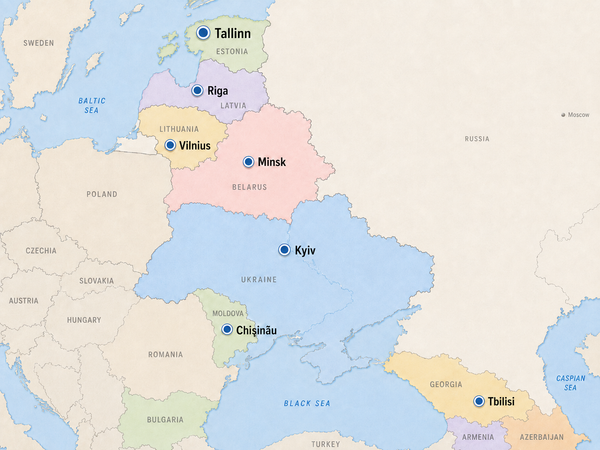
Yet resistance remains strong. Citizens in Serbia and Georgia continue to take to the streets against corruption, electoral manipulation and the concentration of power. After more than thirty years of dictatorship, Belarus still has a democratic movement. It operates largely underground or from abroad, but it has not disappeared. In the United States, the No Kings demonstrations brought millions of people onto the streets. Estimates place the movement among the largest protest mobilisations in American history.
The divide between democracy and autocracy is also one of the deepest political dimensions of Russia's war against Ukraine. Ukraine's struggle for sovereignty and democratic self-government did not begin with the Maidan protests or the Orange Revolution. Its outcome will determine more than Ukraine's future borders. It also affects the scope for democratic change in Georgia, Moldova and Belarus, among other countries. Each has its own history and conflicts, but all are affected by the wider confrontation between democratically accountable government and authoritarian power.
Russia formally retains several parties, but political choice is increasingly window dressing. United Russia dominates the state apparatus. The Communist Party is allowed to oppose the government within the system's boundaries, while the liberal, anti-war Yabloko was barred from the parliamentary elections of September 2026. Nor does North Korea, a Russian ally, offer meaningful political choice. Party, state and dynastic power there almost completely coincide.
Support for Ukraine therefore goes far beyond drones and ammunition. It concerns who we are and what we wish to remain. The ancien régime did not end on 11 September 1789, but that day made visible that power would henceforth have to be debated, distributed and limited in a representative assembly. On 8 May 1945, a totalitarian regime was defeated militarily. On 9 November 1989, another dictatorship lost its grip under pressure from citizens. Since 24 February 2022, the same political question has once again hung over Europe.
Do citizens determine the direction of society, and can they grant, limit and withdraw power? Or do rulers decide how much freedom citizens receive and how society is organised?