Russia Has a History. It Does Not Own Everyone Else's
The Soviet bloc disappeared more than three decades ago. Its mental map did not. Ukraine, Georgia, Moldova and Belarus are still too often described through Moscow — as buffers, backyards or “post-Soviet space”. It is time to put these countries back at the centre of their own histories.
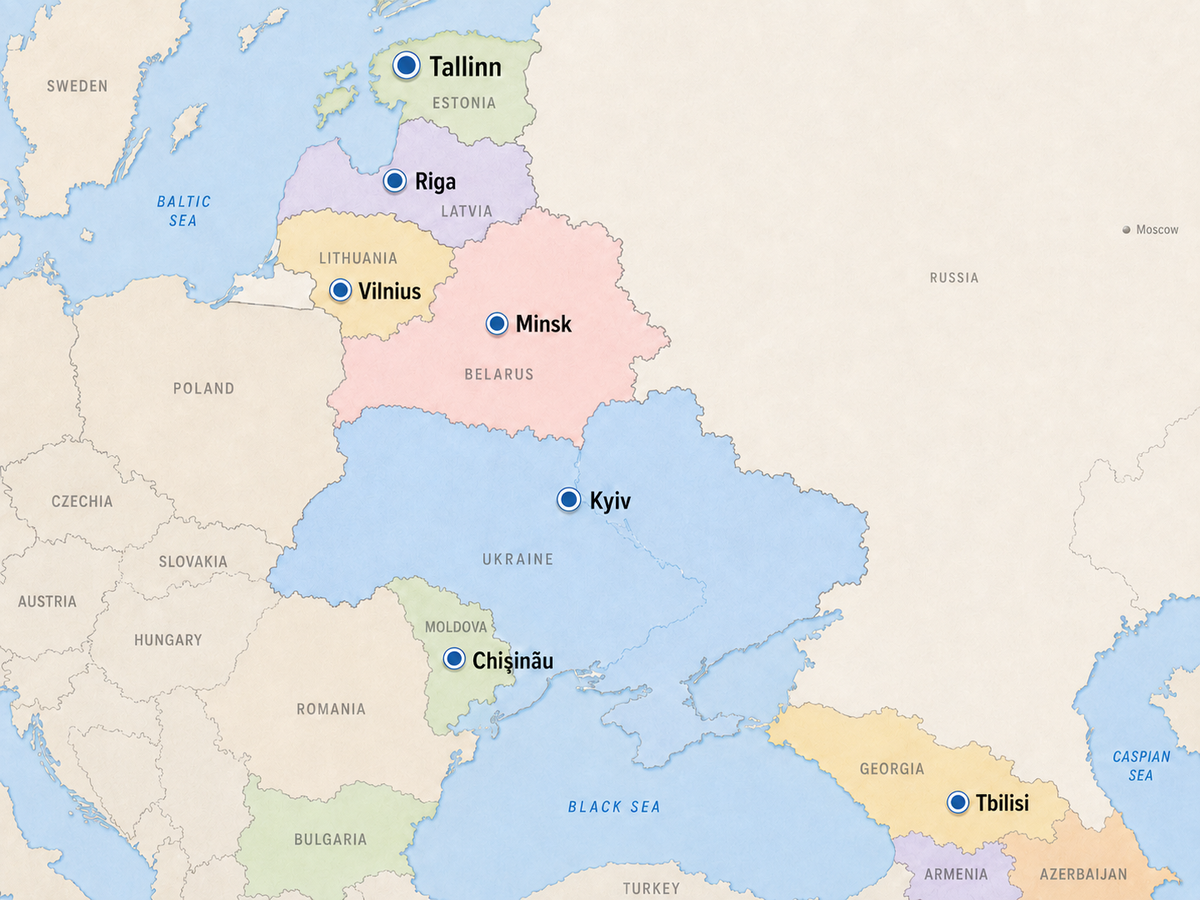
The Soviet-controlled bloc disappeared more than three decades ago, but its mental map remains intact.
1. The bloc that survived its own disappearance
“Eastern Bloc”, “former Soviet republic”, “Russia’s backyard”, “buffer state”, “post-Soviet space”... That Putin thinks and speaks in such terms is one thing. Perhaps it is not surprising after more than a quarter of a century on the throne and years spent withdrawing into bunkers and palaces behind very long tables, with few people nearby willing to contradict him.
When people in the West still use the same terminology, it is rather more unusual. At best, it is a form of nostalgia: a sign of being stuck in the past and in the categories of the Cold War. When I hear it, I sometimes think of Good Bye, Lenin!, the film about the absurd effort to preserve the vanished world of the GDR after the Wall has already fallen. There is nothing inherently wrong with nostalgia, of course, unless it seriously distorts our view of reality and starts guiding political choices - including choices that determine the future of others.
In the West, that nostalgia may amount to little more than red memorabilia and tasteless ornaments decorated with hammers and sickles. In the east of our continent, its political translation is considerably less harmless.
What these expressions have in common is that they place Moscow at the centre of the map. Belarus becomes a detached piece of Russia instead of a country with a history of its own. Georgia becomes a territory between Russia and Turkey instead of a civilisation in its own right. Ukraine becomes an appendage that drifted away from Moscow instead of a political and cultural community whose history is, in part, older than Moscow itself.
That is the blind spot.
2. Geography written by empire
To people in the western part of the continent, Ukrainian insistence on using the correct forms of place names can sometimes seem excessive; some even interpret it as a petty exercise in provoking Russians. In reality, it is above all an expression of self-determination. It conveys a very simple feeling: we will no longer allow our future and our geography to be defined by people who do not belong to our political community, still less by people who have tried to destroy it. Ukraine, Georgia, Moldova, Belarus, Estonia, Latvia and others have the same right as any other political community to decide their own future.
This is a principle that the West itself began to formulate at the end of the eighteenth century. The American and French Revolutions marked a transition, however incomplete, from a vertical political order to one based on popular sovereignty: now it was up to “we the people”. Human beings were to be regarded as political equals - as the American Declaration of Independence famously put it, “all men are created equal” and possess certain “unalienable Rights”. A people therefore does not need a monarch or another supposedly superior power to determine the direction in which it may develop.
That is precisely the autonomy Ukrainians, Moldovans, Belarusians and Georgians claim today: no more and no less. It is no coincidence that questions of names, spelling and historical terminology have become politically charged across the region. Their demand is not for a world without Russia. It is for a world that is no longer coloured in by the Kremlin. Russia has a history, and it is entitled to that history. It is not entitled to the histories of other countries.
3. Four countries, four acts of erasure
Ukraine, Georgia, Moldova and Belarus each face particular forms of imperial erasure, ranging from brutal military destruction to slower political and cultural assimilation. Hard military power and softer hybrid methods can both be used to suppress sovereignty, language, historical memory and political orientation - ultimately replacing a society’s ability to define itself with a definition imposed from outside.
Ukraine
The most visible and large-scale example is Ukraine. Newspapers and television understandably show bombs, missiles and destroyed buildings, but this is more than a military struggle. The war has also damaged cultural heritage, museums, archives and civilian infrastructure. By 29 July 2026, UNESCO had verified damage to 545 cultural sites. A joint assessment by the World Bank, the Government of Ukraine, the European Union and the United Nations estimated direct damage to culture and tourism at $4.5 billion.
In occupied territories, erasure continues through institutions and everyday life. United Nations investigators have documented the imposition of Russian citizenship and curricula, restrictions on Ukrainian-language education, the removal of Ukrainian books and cultural symbols, compulsory Russian “patriotic” education, and the forcible transfer and deportation of children. In March 2026, the UN Commission of Inquiry concluded that the deportation and forcible transfer of Ukrainian children constituted crimes against humanity. The International Criminal Court had already issued arrest warrants in 2023 for Vladimir Putin and Maria Lvova-Belova over the alleged unlawful deportation and transfer of children.
The large-scale removal and re-education of children may be the sharpest form of cultural negation: it rewrites not only the past and present, but the future. Listen to Putin or Medvedev and Ukraine is repeatedly reduced to something resembling a Russian province, while Ukrainian culture and the people who create it become footnotes to a supposedly larger Russian history. The full-scale invasion has produced the opposite effect: Ukraine has become more visible, more distinct and more present in global consciousness.
Georgia
In Georgia, similar mechanisms operate on a less visibly destructive scale. The underlying logic is nevertheless familiar: Georgia and its population are not treated as fully autonomous actors entitled to write their own future. The continuing occupation of Abkhazia and South Ossetia is a physical reminder that Moscow can still try to determine where borders and political freedom begin and end. Every fence shifted and every boundary moved is an amputation of Georgian territorial integrity and sovereignty.
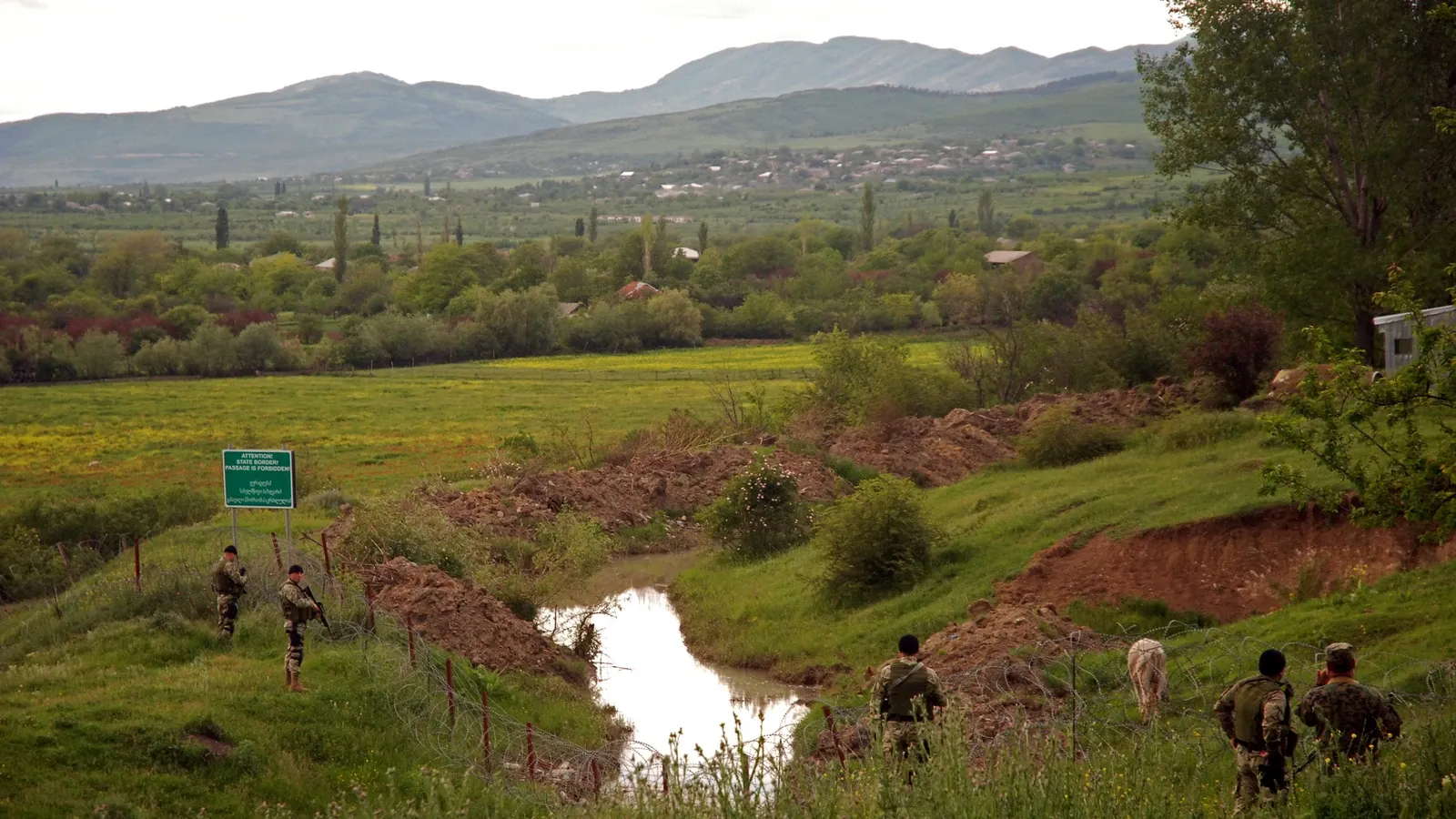
Political pressure works alongside territorial fragmentation. Russia has backed actors and narratives hostile to deeper European integration, while Georgia’s pro-European movement has remained remarkably persistent. Recent CRRC research continues to find large majorities supporting EU membership. The argument is therefore not only about territory. It is about whether Georgians themselves are entitled to decide to which political community they wish to belong.
Moldova
A related strategy is visible in Moldova. The continuing Russian military presence in the breakaway region of Transnistria, together with support for pro-Russian political actors, prevents Chișinău from exercising full territorial control and sustains a condition of permanent division.
Language is another arena of pressure. Romanian is the official language; Moldova’s Constitutional Court has confirmed this, while Russian and other minority languages enjoy legal protection. Yet the label “Moldovan” has for decades been used politically to encourage the idea of a language and identity fundamentally separate from Romanian, thereby limiting the country’s cultural and political connection with neighbouring Romania and, by extension, the European Union.
A similar pattern appears when Moscow and pro-Russian actors claim that Russian speakers are structurally discriminated against. Such narratives mobilise groups around the fear that European integration will cost them their language or culture. Linguistic tensions are especially visible in Transnistria and Gagauzia. Language in Moldova has therefore long ceased to be a neutral means of communication; it has become one of the front lines between a pro-European future and the Russian sphere of influence.
Belarus
In Belarus, pressure from Moscow penetrates deeply into politics, the economy, security and culture. The Lukashenka regime has made the country heavily dependent on Russia, hollowing out a large part of its practical policy freedom and sovereignty. The Belarusian language has for decades been pushed to the margins of education, media and public life. Russia has also used Belarusian territory as a staging ground for military aggression against Ukraine.
It is important, however, not to confuse Belarus with the regime that governs it. Belarus remains a distinct country and political community. The very dependence that now constrains it is part of the argument: a state can retain its formal borders while losing much of its ability to choose its own direction.
4. The diversity hidden behind “the East”
Language, religion, architecture, imperial history, political traditions and collective memory differ enormously across the region.
There are far more shades and colours in Eastern Europe than many people in the West still assume. The Soviet Union tried to homogenise large parts of the region politically and culturally, but the fact that it never fully succeeded is evidence of how deep and resilient the historical, linguistic and cultural roots of these societies are.
Some countries in the region speak Slavic languages, but even there the differences are substantial. In Moldova, the official language is Romanian, a Romance language. Georgian belongs to the Kartvelian language family and is written in its own centuries-old Mkhedruli script. Ukrainian and Belarusian are East Slavic languages in their own right, not dialects of Russian.
The fact that many Ukrainians, Belarusians, Moldovans and Georgians understand Russian has much to do with centuries of Russian and Soviet dominance, with Russian serving as an administrative language and lingua franca, and with periods of active Russification, including through education.
Nor does the Cyrillic alphabet prove a Russian identity. Ukrainian, Belarusian and Russian use different Cyrillic alphabets. Elsewhere in the former Soviet space, including Kazakhstan and Uzbekistan, debates and reforms concerning a shift towards the Latin alphabet have also reflected wider questions of identity and political orientation.
Religion is no more homogeneous. Eastern Orthodox Christianity is important in Ukraine, Georgia, Moldova and Belarus, but their ecclesiastical structures and historical relationships with Moscow differ considerably. The Orthodox Church of Ukraine received autocephaly in 2019, establishing an independent church outside the authority of the Moscow Patriarchate. The Georgian Orthodox Church is among the oldest Christian churches in the world and possesses a deeply rooted religious and national tradition of its own. Orthodoxy in Moldova is institutionally divided, while the Belarusian Orthodox Church remains closely tied to the Moscow Patriarchate.
Shared religious traditions, linguistic families or centuries of Russian influence therefore do not erase difference. Cultural proximity is not political ownership.
5. The liberal principle
Nations and political communities have the right to determine their own institutions and alliances. Not because every form of nationalism is good, but because imperial domination is not an acceptable cure for nationalism.
Liberal patriotism protects the right of a community to govern itself. Aggressive nationalism claims the right of that community to dominate others.
Self-determination versus domination
Liberal patriotism is defensive and universal: it protects the freedom of one’s own community while recognising that every other community possesses the same right. Chauvinistic nationalism is offensive and exclusive: it treats one nation as superior and claims a right to rule over others.
Empire as the wrong medicine
Imperialism suppresses the natural need for cultural and political identity. Trying to erase national difference by force does not eliminate nationalism; it can intensify precisely the defensive and radical forms of nationalism that empires claim to oppose.
The distinction between self-determination and domination is the product of a long political and philosophical evolution.
Before the modern nation-state
Before the Enlightenment challenged the absolute authority of monarchs, political loyalty was organised very differently from the way we understand citizenship today. For long periods, allegiance was owed principally to a ruler, dynasty or religion rather than to a modern nation. Borders changed through dynastic marriages and wars with little or no participation by the people who lived within them.
In ancient Roman and later republican traditions, patria - the fatherland - referred above all to loyalty to the political community, its laws and the res publica, rather than to an ethnic group. Duty to the community could take precedence over the individual. Horace’s famous phrase, “Dulce et decorum est pro patria mori”, expressed the ideal that it was sweet and honourable to die for one’s country.
The Enlightenment and the principle of popular sovereignty changed the source of legitimate authority. Thinkers such as Jean-Jacques Rousseau helped articulate an order in which power no longer flowed from God or the monarch, but from the people themselves. The sovereign was increasingly understood not as a king, but as a political community. That development opened the door to the modern idea of the nation.
The split in the idea of the nation
Nationalism therefore initially had an emancipatory meaning as well: it could liberate a people from absolute rulers and empires. At roughly the same time, the individual was also being emancipated from inherited status, estate and occupation. Political modernity thus contained two liberations at once - of the individual and of the collective.
The tension between those two forms of emancipation helped produce two very different paths. One understands national community as a framework for civic freedom and self-government; the other turns national identity into a claim to prestige, superiority and domination.
• Liberal patriotism / civic self-determination: self-determination and freedom; inclusive membership through citizenship, law and constitutional order; mutual recognition of sovereignty.
• Aggressive nationalism / imperial domination: power, prestige and hierarchy; exclusion through ancestry or, at its extreme, “blood and soil” (Blut und Boden); spheres of influence, domination and imperialism.
National self-determination without respect for the freedom of others can therefore mutate into aggressive nationalism and imperialism. Genuine political freedom requires the freedom of the neighbour as well.
6. The political consequences of ignorance
Our geopolitical ignorance and lack of knowledge about Eastern Europe may seem harmless, but they have contributed to underreaction, miscalculation and the acceptance of Russian sphere-of-influence thinking. This is what the phrase “cultural ignorance prepares the ground for geopolitical indifference” means in practice: when politicians and the public know little about another country’s culture and history, they can respond more passively when that country is attacked or coerced.
How the mechanism works
The unfamiliar is easier to disregard. Without knowledge of a nation’s language, art, literature and history, it becomes an abstract dot on a map rather than a community to which we feel any intellectual or emotional connection.
Ignorance also normalises aggression. If people do not know that a country possesses a distinct identity and history, an aggressor’s claim that it “historically belongs” to a larger neighbour can sound more plausible. That makes it easier for leaders such as Putin to spread historical distortions and political myths at home and abroad.
Finally, ignorance dehumanises conflict. Political decision-makers begin to treat the struggle of millions of people for their freedom as a transactional border dispute or a distant inconvenience - something that matters because of energy prices or the cost of a shopping basket rather than because it concerns political agency, self-determination and, ultimately, life and death.
Concrete examples
Before 2022, Western Europe had spent decades paying too little attention to Ukrainian identity, history and culture. Ukraine was still too often imagined as “a former Soviet republic where everyone speaks Russian” and therefore somehow naturally oriented towards Moscow. That blind spot contributed to the tepid, indifferent and ultimately costly Western response to the annexation of Crimea in 2014.
The same ignorance sustains buffer-state thinking. When the cultural and democratic traditions of Ukraine, Georgia or Moldova are unfamiliar, it becomes easier to treat them as pieces on a geopolitical chessboard: buffers whose purpose is to give larger powers strategic distance or reduce the risk of direct confrontation.
The unfamiliar is therefore not only easier to disregard; it can also become easier to sacrifice. Political scientist Tanisha Fazal’s work on “state death” is relevant here: the survival of smaller states depends not only on formal borders but on an international order that recognises their continued sovereignty. Once a country is imagined merely as a buffer, abandoning it becomes psychologically easier.
Agency and sovereignty
Treating a country as a buffer objectifies it. The state becomes a passive geographical instrument serving the security calculations of greater powers, while the voice, culture and democratic choices of the people living there disappear from the sentence.
International law
The United Nations Charter begins from the sovereign equality of states and prohibits the threat or use of force against their territorial integrity or political independence. It also recognises the principle of equal rights and self-determination of peoples. That does not mean that every political claim automatically creates a right to secession. It does mean that a neighbouring power possesses no general veto over another state’s political future.
Geopolitical insecurity
From the perspective of a great power, a buffer may provide temporary strategic depth. But grey zones can make smaller states more vulnerable to pressure, destabilisation and armed intervention when their security status is permanently contested. Sphere-of-influence thinking therefore risks recreating the very instability it claims to manage.
7. Change the map in our heads
For much of Eastern Europe, 1945 was not a simple transition from dictatorship to liberty. Nazism was defeated, but political self-government did not follow everywhere. In Poland, the Baltic states, western Ukraine and the Soviet occupation zone in Germany in particular, the end of Nazi rule was followed by renewed coercion, repression and Soviet domination. The ideology and machinery were different, but the lived experience could contain a brutal continuity: political agency remained constrained and decisive power was again located elsewhere. Berlin had fallen; for millions, Moscow now set the limits.
For Western Europe, 1945 became the beginning of reconstruction and democratic integration. For much of Central and Eastern Europe, liberation from Nazism did not yet mean the freedom to determine a political future.
Not an identical nightmare - Nazism and Soviet communism must not be collapsed into one undifferentiated evil - but a repeated experience of domination, repression and denied political agency.
Ghosts from the past
What Ukrainians are resisting today is therefore not merely territorial conquest. It is also resistance against a ghost of the past that resurfaces time and again: an external power attempting to impose its will, culture and truth, and to colonise the right to self-determination. A city like Kharkiv passed through at least ten changes of governing authority between the revolutions of 1917 and the final Soviet recapture in 1943. Again and again, armies, governments and borders changed around the people who lived there. A century later, the pattern returned in another form: Kharkiv faced an attempted separatist takeover in 2014 and a Russian assault in 2022, yet remained under Ukrainian control. For people in such regions, another army crossing the border is therefore not an abstract geopolitical event. It enters a much longer memory of governments, borders and identities repeatedly being decided by somebody else. That history helps explain why another attempt to seize a city can carry a meaning much deeper than territorial loss alone - and why attachment to home in eastern Ukraine can be extraordinarily difficult to understand from the outside.
The attack on and occupation of their land can therefore mean much more to Ukrainian citizens than it sometimes appears from the outside. It also means:
Not you, but Moscow determines your history.
Not you, but Moscow determines your borders - and on which side of the line your house stands.
Not you, but Moscow determines with which countries you may enter into agreements, relations and alliances.
Not you, but Moscow determines the legitimacy and right to exist of your country - or whether your country is a country at all.
Putin himself provided the ideological proof. In his 2021 essay on the “historical unity” of Russians and Ukrainians, he presented Russians and Ukrainians as essentially “one people”. In his address of 21 February 2022, three days before the full-scale invasion, he portrayed modern Ukrainian statehood as artificial and inseparable from Russian history and culture. These are not merely assertions about shared ancestry. They deny Ukraine the right to interpret its own history independently. That rhetoric echoes a much older imperial tradition in which language, elites, borders and historical memory were repeatedly subordinated to decisions made in Moscow. The current occupation turns that political negation into practice. Rewritten schoolbooks, imposed curricula and the removal of Ukrainian symbols translate an argument about history into control over everyday life.
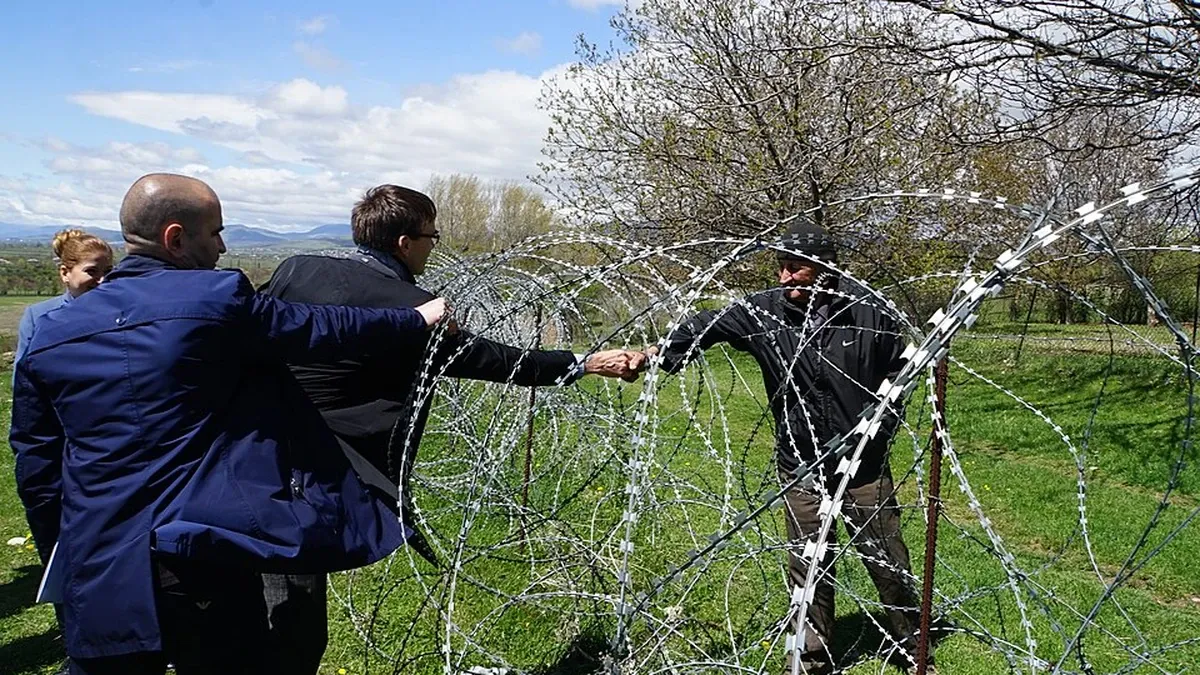
To give Eastern Europe a future on its own terms, we must change our mental map. Decolonising Europe’s mental geography begins by allowing Tallinn, Riga, Vilnius, Minsk, Kyiv, Chișinău, Tbilisi and Sarajevo to become centres of their own stories.
Selected sources and further reading
The essay draws on the author’s own reading and research. The sources below support the main empirical, legal and documentary claims in the text.
UNESCO. Damaged cultural sites in Ukraine
World Bank, Government of Ukraine, European Union and United Nations. Rapid damage and needs assessment for Ukraine (culture and tourism figures, 2026)
United Nations Commission of Inquiry on Ukraine. Commission concludes that the deportation and forcible transfer of Ukrainian children constitute crimes against humanity (March 2026)
International Criminal Court. Situation in Ukraine: arrest warrants for Vladimir Putin and Maria Lvova-Belova (2023)
European Union Monitoring Mission in Georgia. Mandate and background on Georgia, Abkhazia and South Ossetia
CRRC Georgia. Research on public attitudes towards the European Union in Georgia (2026)
Constitutional Court of the Republic of Moldova. Judgment No. 36 of 5 December 2013 on the Romanian language
United Nations. Charter of the United Nations, Chapter I
Tanisha M. Fazal. “State Death in the International System”, International Organization 58(2), 2004
Laura Starink, RAAM op Rusland. “Het verzet van grensstad Charkiv tart de Russen al tien jaar”
Vladimir Putin (primary source). “On the Historical Unity of Russians and Ukrainians” (12 July 2021)
Vladimir Putin (primary source). Address of 21 February 2022