He Who Made My European Blind Spots Less Blind
Mathieu Segers taught me to look at Europe from above and below: through institutions and treaties, but also through cafés, literature and everyday life. A personal tribute to the thinker who made my European blind spots less blind.
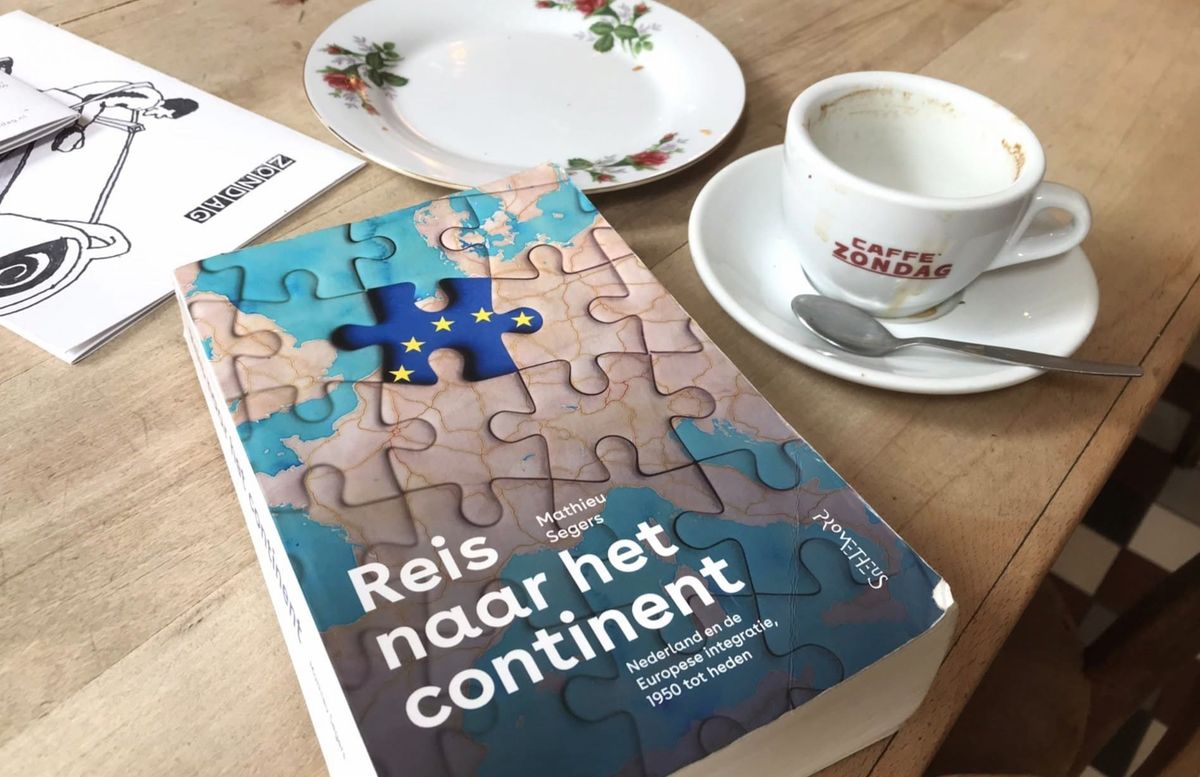
In a certain sense, I dedicate this project to Mathieu Segers — not only out of gratitude for what he wrote about Europe, but above all for the way he taught me, and many others, to look at it. At Europe from above and below, from north, south, east and west, through the eyes of policymakers and writers, historians and citizens. Mathieu made my European blind spots less blind. Europe’s Blind Spots wants to continue looking from that widened perspective.
I am sometimes envious of the perspective from which Mathieu looked at Europe. If I could, I would like to borrow his eyes for a day: that exceptionally sharp, layered, analytical and at the same time deeply human way of seeing. But even without possessing that gaze, he taught me to look differently — at Europe, at the world and at people. More broadly, more deeply, more fundamentally. Not only in an abstract intellectual sense, but also in a very concrete, social and human one.
What has always struck me in his work is the way he managed, like few others, to connect the discourse of high politics with the European living room. He could translate structures into streets, institutions into people, treaties into everyday life. With him, Europe never remained confined to the language of summits, councils, treaties and institutional diagrams. He understood how decisions made in Brussels and Strasbourg filter down into cafés and market squares, into national memories, into the sensitivities of citizens and into the often invisible fabric of society.
For me, that is one of his greatest achievements: he did not describe Europe as a machine, but as a living whole.
Europe from Above and Below
Mathieu taught me to look at Europe simultaneously from above and from below.
From above: as a space of institutions, power, legislation, diplomacy, political leaders, historical compromises and geopolitical interests. He understood the logic of Paris and Berlin, Brussels and Strasbourg, treaties and decision-making. He could analyse with great precision how the European Union really functions, and how national interests, historical sensitivities and political power continually shape one another.
But he looked just as insistently from below. At the street and the café, at literature and language, at the small and large historical memories beneath the European construction. He understood that Europe does not exist only in conference rooms, but also in the everyday lives of people: in the ways they live together, remember, talk, fear, hope and relate to one another.
That double perspective — institutional and human, structural and cultural — is what made his work so distinctive to me. Europe only becomes truly visible when we try to see both levels at once.
Making the Different Europes Understandable to One Another
What Mathieu also managed to do, like few others, was not to play Europe’s different perspectives off against one another, but to make them intelligible to each other.
He understood that northern Europe often looks at the continent differently from the south, that the east carries historical experiences and security instincts different from those of the west, and that European reality is not uniform. Precisely there lies its difficulty — but also its richness.
He understood why countries in northern Europe, as well as the Netherlands or Germany, often emphasise stability, fiscal discipline and institutional caution. But he understood equally well why southern countries such as Italy, Spain, Greece or France, shaped by different historical, economic and political experiences, are often more inclined to emphasise solidarity, political cohesion and further integration.
Nor did he overlook Europe’s eastern flank.
On the contrary: his way of looking helped me understand how long the European perspective was largely shaped from Paris, Berlin and other western European capitals. From the relative comfort of western Europe, the security concerns of Poland, the Baltic states or Finland could easily be dismissed as exaggerated or peripheral. Russia was perceived differently there; memories of occupation, domination and enforced dependency felt much more distant in the west.
At the same time, southern Europe has other immediate geographical realities: migration across the Mediterranean, relations with North Africa, and, for countries such as Greece and Cyprus, the complex relationship with Turkey. Different threats and different histories produce different ways of looking.
Mathieu managed to bring those perspectives together without reducing them to caricatures. He showed that Europe is not a flat map, but a space of overlapping histories, interests, traumas, memories and expectations.
Maastricht: Great Europe and Small Europe
Perhaps that is why Maastricht suited him so well.
Mathieu was born there and eventually returned with his family after periods of living and working elsewhere. The city was also connected to one of his earliest European memories. During the European summit of December 1991, the fifteen-year-old Mathieu tried to catch a glimpse of the leaders gathered for the negotiations that would result in the Maastricht Treaty. First he walked from Wyck to the hotel where Helmut Kohl was staying. When high fences prevented him from getting close, he got on his bicycle and headed towards the provincial government building on the Maas, hoping to see François Mitterrand, Giulio Andreotti or one of the other protagonists. In the end, like almost everyone else, he had to follow the summit on television.
It is an almost symbolic anecdote: the grand politics of Europe literally descending upon the streets in which someone grows up.
Maastricht marked the culmination of a broader wave of integration. Under Jacques Delors, and with the political support of figures including Kohl and Mitterrand, an important chapter of post-war European integration was brought together and a new phase was opened. Earlier steps — the Single European Act, Schengen, Erasmus — had already brought the continent closer together. Maastricht gave that process renewed direction and political depth.
Yet Maastricht also reveals how that great Europe constantly exists alongside a much smaller Europe.
Europe at the Window
Why did Mathieu so often come to Café Zondag? Why this place, this counter, these windows?
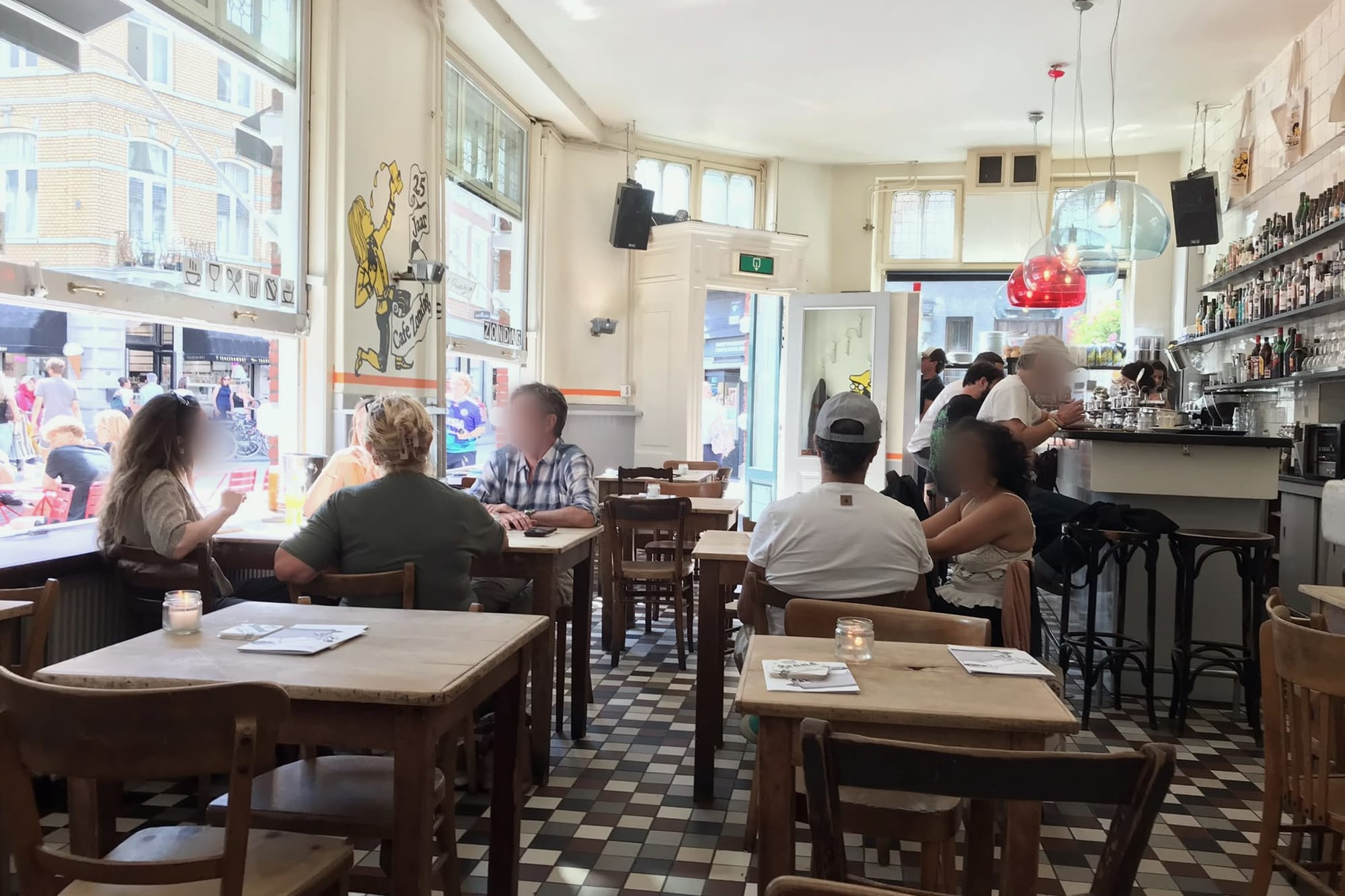
Was it the view of the streets, filled with people of every colour and kind? The boundary between inside and outside feels particularly thin here. Through the large windows the city almost seems to flow into the café: passers-by, bicycles, voices and unexpected encounters.
As I try to imagine what impressions this place might have left on him, I hear French, German, Polish, Italian, English, Dutch and, of course, Maastricht dialect around me. Someone talks about a visit to Barcelona. Someone else is surprised by an old friend suddenly appearing at the window. Elsewhere I catch fragments of conversations about holidays and weekend plans. At the tables, conversations begin, are interrupted and resume again; outside, glances cross before people move on.
Perhaps that was precisely what attracted Mathieu to Café Zondag: different perspectives on European society drifting in from every direction. Not in the form of policy papers or grand declarations, but as voices, gestures and everyday encounters.
Amid all the movement and apparent chaos, one constant stands out: people recognise and acknowledge one another. A glance through a window, a greeting at the counter, a conversation that fans out towards other places and other lives. Every encounter briefly opens another way of looking at the world.
Europe itself is also a plural mosaic: made up of different voices, languages, memories and ways of seeing. Not a simple or uniform reality, but the outcome of a layered history and culture.
Perhaps Mathieu did not find a miniature version of Europe here. Perhaps that would be too easy.
But he may have found a place from which Europe could be observed: up close, constantly in motion, and always from more than one perspective at once.
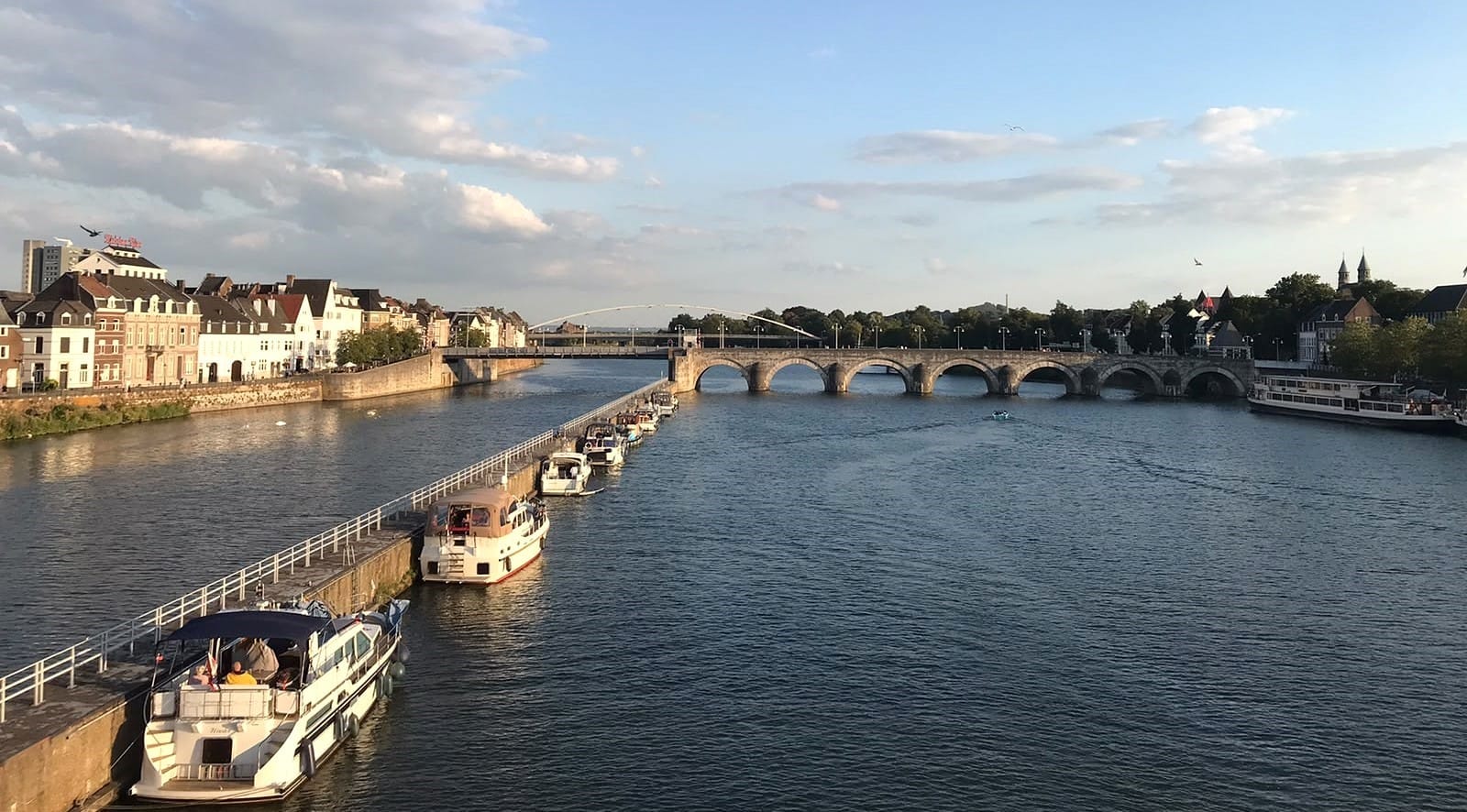
When I now walk across the Vrijthof or the Markt, I try to look at Maastricht in the same way: as a place that can be both deeply rooted and cosmopolitan. The great Europe of treaties, universities and politics exists alongside the small Europe of cafés, conversations, markets and accidental encounters.
One can hardly be understood without the other.
Literature as a Way into Europe
Another reason Mathieu became such an essential voice for me was his conviction that Europe cannot truly be understood through the language of policy alone.
Anyone who looks at Europe only through non-fiction, treaties, statistics and political analysis sees a great deal — but not everything. Mathieu emphasised the power of literature as a way into the continent. The great European novels were not, for him, decorative additions to history or politics, but another way of knowing Europe.
That insight has stayed with me deeply.
Novels and stories can expose layers that easily disappear from policy documents and journalistic analyses. They reveal humiliation, loss, melancholy, violence, longing, hope and ambiguity. They show how great historical transformations run through individual lives. They give Europe not only structure, but human texture.
Through writers such as Curzio Malaparte, another language is added to the institutional and political vocabulary of Brussels and Strasbourg. A language that is less orderly, perhaps, but sometimes comes closer precisely because of that to the contradictions of the continent itself.
It is one of the most valuable lessons I have taken from Mathieu: political knowledge alone is not enough. Anyone who wants to understand Europe must also learn to read and listen, to look and to feel. Not only at the conclusions on the surface, but also at the currents underneath.
Europe as a Federal Whole
Mathieu also taught me to look at Europe in a fundamentally federalist way.
Not as a grey mass in which differences must ultimately disappear. Nor as an accidental collection of states that merely tolerate one another out of strategic self-interest. But as a whole in which distinct identities, histories and political cultures acquire meaning precisely through their combination.
Perhaps that is the deeper thought behind my image of Europe as a layered cake.
Not because countries or populations can be reduced to simple flavours. But because each layer possesses its own colour, texture and history. Those layers can be studied separately, and their own logic deserves to be understood. A federalist perspective demands precisely that respect for difference, autonomy and distinctiveness.
Yet together they create something that none of the separate parts possesses on its own.
If all the layers are completely mixed together, the ingredients may remain the same, but their structure and individuality disappear. If you taste only one layer and believe you have thereby understood the whole cake, you miss the whole.
Europe, therefore, is no longer simply the combination of a former Eastern Bloc and a western European bloc that after 1945 was strongly shaped by the transatlantic relationship, American security guarantees and Marshall aid. Out of those very different experiences, something new has emerged. The separate histories remain, but their combination has created a new political, social and cultural reality — with a colour and flavour of its own.
For me, that is a deeply federalist idea.
Unity does not necessarily arise from uniformity. It can emerge precisely from giving political form to difference without erasing it.
And here too, the position from which we look matters. From a distance, we see a single whole. Move closer and the separate layers, fractures, overlaps and connections appear. Only when we are prepared to move between those perspectives does the full story begin to come into view.
Looking
If I had to summarise the relevance of Mathieu Segers to me in one word, it would be: looking.
Looking differently. Looking with more nuance. Looking in layers. With greater historical depth, greater geographical breadth and greater human attention.
Not remaining trapped in clichés, national reflexes, easy oppositions or superficial analysis. But trying to see how societies are shaped by history, memory, structures, interests, ideas and emotions.
That, ultimately, is also one of the fundamental tasks of the historian: to learn to look again. Through numbers and data, events and original sources, socio-economic circumstances and human testimony, to reconstruct a context that can easily disappear when viewed only from the present.
Without — however tempting it may sometimes be — becoming trapped in nostalgia. The past should deepen our view of the present, not cloud it.
Mathieu taught me that Europe can only be understood if we are willing to look beyond the immediately visible layer.
Why I Dedicate This Project to Him
If there is one person who changed and deepened my perspective on Europe, who made me understand and experience Europe differently — and perhaps, as a result, live a little differently too — it is Mathieu Segers.
For that, I am grateful to him.
That is why he is one of the inspirations behind this project. That is why I also dedicate part of Europe’s Blind Spots to him.
Not as a ritual gesture, but because he genuinely shifted something in the way I look. He taught me that much of what is essential about Europe can be found precisely in the corners and edges that easily disappear from the grand political debate.
In the history behind an institution.
In a novel behind a political conflict.
In the perspective of a country looking at the same map from the other side.
Or simply in a café in Maastricht, at a window where different languages, stories and lives briefly cross.
He made my European blind spots less blind.
And perhaps that is also what this project, at its best, should try to do.